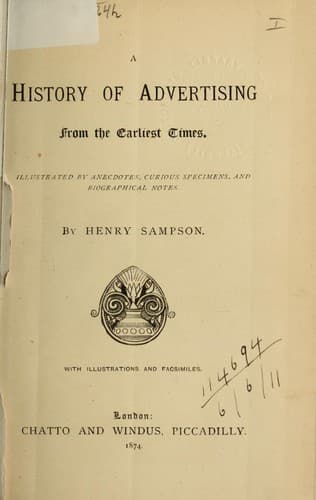
A History of Advertising from the Earliest Times.Sampson, Henry
History
A History of Advertising from the Earliest Times.
Sampson, Henry
Advertising -- History
From the foregoing can be traced the gradual growth of street
advertising until it has reached its present extensive pitch; and though
the process may be characterised as slow, no one who looks around at the
well-covered hoardings and the be-plastered signs on detached and
prominent houses can doubt that it is sure. Proclamations, and suchlike
official announcements, were probably the first specimens of street
advertising, as we now understand the term; but it was not until
printing became general, and until the people became conversant with the
mysteries of reading and writing, that posters and handbills were to any
extent used. Mention is made in 1679 of a tradesman named Jonathan
Holder, haberdasher, of the city of London, who gave to every purchaser
to the extent of a guinea a printed list of the articles kept in stock
by him, with the prices affixed. The paper in which this item of news
was recorded seems to have regarded Mr Holder’s practice as a dangerous
innovation, and remarks that it would be quite destructive to trade if
shopkeepers lavished so much of their capital in printing useless bills.
This utterance now seems ridiculous; but in the course of another two
centuries many orthodox opinions of the present day will receive as
complete a downfall as that just recorded.
Within the recollections of men who are still young street advertising
has considerably changed. Twenty years ago the billsticker was a
nuisance of the most intolerable kind, and though we can hardly now
consider him a blessing, his habits have changed very much for the
better. Never heeding the constant announcement to him to beware, the
billsticker cared nothing for the privacy of dead walls, or, for the
matter of that, of dwelling-houses and street doors; and though he was
hardly ever himself to be seen, his disfigurative work was a prominent
feature of the metropolis. It was also considered by him a point of
honour--if the term may be used in connection with billstickers--to
paste over the work of a rival; and so the hoardings used to present the
most heterogeneous possible appearance, and though bills were plentiful,
their intelligibility was of a very limited description. Sunday morning
early used to be a busy time with the wandering billsticker. Provided
with a light cart and an assistant, he would make a raid on a whole
district, sticking his notices and disappearing with marvellous
rapidity. And how he would chuckle as he drove away, more especially if,
in addition to disfiguring a private wall, he had succeeded in covering
over the handiwork of a rival! For this reason the artful billsticker
used to select a time when it was still early enough to evade detection,
and yet late enough to deface the work of those who had gone before him.
Billsticking was thus an art attended with some difficulties; and it was
not until the advent of contractors, like Willing, Partington, and
others, that any positive publicity could be depended upon in connection
Public-domain text, read in full here on John Shaqi.
Reviews
Reviews
No reviews yet
Be the first to share your thoughts on this work.
Join the Discussion
Join the discussion
Sign in to leave a comment or review.
Sign InorCreate an account