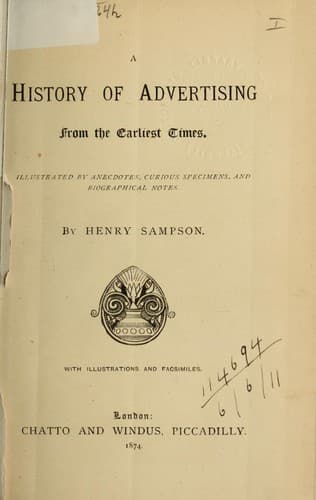
A History of Advertising from the Earliest Times.Sampson, Henry
History
A History of Advertising from the Earliest Times.
Sampson, Henry
Advertising -- History
Not long ago the promoters of a patent umbrella, which seems to have
gone the mysterious way of all umbrellas, patent or otherwise, and to
have disappeared, availed themselves of a great boat-race to attract
public attention to their wares. Skiffs fitted with sails, on each of
which were painted the patent parapluie, and a recommendation to buy
it, dotted the river, and continually evaded the efforts of the
Conservancy Police, who were endeavouring to marshal all the small craft
together, so as to leave a clear course for the competitors. Every time
one of these advertising boats broke out into mid-stream, carrying its
eternal umbrella between the dense lines of spectators, the
advertisement was extremely valuable, for straying boats of any kind are
on such occasions very noticeable, and these were of course much more
so. Still it would seem from the sequel that this bold innovation had
been better applied to something more likely to hit the public taste;
for whether it was that people, knowing how fleeting a joy is a good
umbrella, were determined not to put temptation in the way of their
friends, or whether the experiment absorbed all the spare capital of the
inventor and patentees, we know not; but this we do know, that since the
time of which we speak little or nothing has been heard of the novel
“gingham.”
Another innovation in the way of advertisements was that, common a few
years back, of stencilling the flagstones. At first this system assumed
very small proportions, a parallelogram, looking like an envelope with a
black border that had been dropped, and containing the address of the
advertiser, being the object of the artist entrusted with the mission.
Gradually, however, the inscriptions grew, until they became a perfect
nuisance, and were put down--if the term applies to anything on such a
low level--by the intervention of the police and the magistrates. The
undertakers were the greatest sinners in this respect, the invitations
to be buried being most numerous and varied. These “black workers” or
“death-hunters,” as they are often called, are in London most persistent
advertisers. They can hardly think that people will die to oblige them
and do good for trade, yet in some districts they will, with the most
undeviating persistency, drop their little books, informing you how,
when, where, and at what rates you may be buried with economy or
despatch, or both, as the case may be, down your area, or poke them
under your door, or into the letter-box. More, it is stated on good
authority, than one pushing contractor, living in a poor neighbourhood,
obtains a list of all the folk attended by the parish doctor, and at
each of the houses leaves his little pamphlet, let us hope with the
desire of cheering and comforting the sick and ailing. To such a man
Death must come indeed as a friend, so long, of course, as the grim king
comes to the customers only.
Public-domain text, read in full here on John Shaqi.
Reviews
Reviews
No reviews yet
Be the first to share your thoughts on this work.
Join the Discussion
Join the discussion
Sign in to leave a comment or review.
Sign InorCreate an account