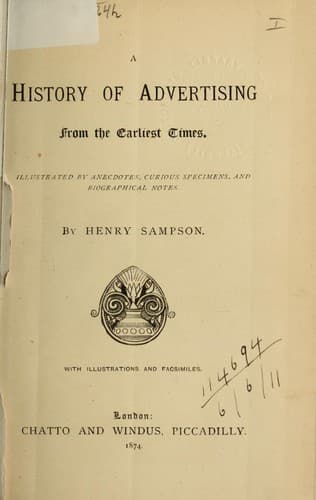
A History of Advertising from the Earliest Times.Sampson, Henry
History
A History of Advertising from the Earliest Times.
Sampson, Henry
Advertising -- History
Placard advertising, of an orderly, and even ornamental, character, has
assumed extensive proportions at most of the metropolitan railway
stations, the agents to whom we have just referred having extended their
operations in the direction of blank spaces on the walls, which they
sublet to the general advertising public. Often firms which advertise on
an extensive scale themselves contract with the railway companies, and
not a few have extended their announcements from the stations to the
sides of the line, little enamelled plates being used for this purpose.
Any one having a vacant space at the side of his house, or a blank wall
to the same, may, provided he live in anything like a business
thoroughfare, and that the vantage place is free from obstruction, do
advantageous business with an advertisement contractor; and, as matters
are progressing, we may some day expect to see not only the private
walls of the houses in Belgrave Square and suchlike fashionable
localities well papered, but the outsides and insides of our public
buildings utilised as well by the hand of the advertiser. One thing is
certain, no one could say that many of the latter would be spoiled, no
matter what the innovation to which they were subjected.
The most recent novelty in advertising has been the introduction of a
cabinet, surmounted by a clock face, into public-house bars and luncheon
rooms. These cabinets are divided into spaces of say a superficial foot
each, which are to be let off at a set price. So far as we have yet
seen, these squares have been filled for the most part with the
promoters’ advertisements only; and it is admitted by all who know most
about advertising that the very worst sign one can have as to the
success of a medium is that of an advertisement emanating from the
promoters or proprietors of anything in which such advertisement
appears. Why this should be we are not prepared to say. We are more able
to show why it should not be; for no man, advertisement contractor or
otherwise, should, under fair commercial conditions, ask another to do
what he would not do himself. So we are satisfied to rest content with
the knowledge that what we have stated is fact, however incongruous it
may seem, which any one can endorse by applying himself to the ethics of
advertising. Certainly, in the instance quoted, the matter looks very
suggestive; perhaps it depends on the paradox, that he who is most
anxious that others should advertise is least inclined to do so himself.
Public-domain text, read in full here on John Shaqi.
Reviews
Reviews
No reviews yet
Be the first to share your thoughts on this work.
Join the Discussion
Join the discussion
Sign in to leave a comment or review.
Sign InorCreate an account