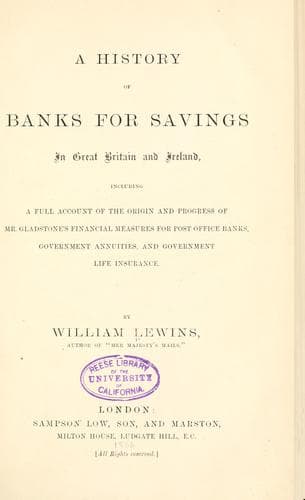
A History of Banks for Savings in Great Britain and IrelandLewins, William
History
A History of Banks for Savings in Great Britain and Ireland
Lewins, William
Postal savings banks -- Great Britain; Savings banks -- Great Britain
It was one thing, however, to carry a Committee of Inquiry in the face
of both the great parties of the House, and another to nominate the
members who should compose it; and this Mr. Reynolds subsequently
found out to his evident chagrin and disappointment. The Government
had clearly not been sufficiently on the alert, and hence they had
been beaten in the first particular; they secured themselves however
against any further defeat. In the following April, Mr. Reynolds
proceeded according to usage to nominate his Committee, which he
wished should consist of eight English and seven Irish members. The
Chancellor of the Exchequer objected, and wished for the reappointment
of the Committee of the preceding session. Mr. Goulburn promptly
assisted by saying, that it would be a reflection on the Committee of
last year if it was not so reappointed. In that Committee there were
only three Irish members, though the subject then, as now, had
exclusive reference to Ireland. Mr. Reynolds, Mr. Herbert, Sir Henry
Willoughby, stoutly contested the point, which ended in the names of
two additional Irish members being proposed. The Government saw the
importance of the question, and that the inquiry would be made in this
way to turn upon the administration of Savings Banks generally, and
the responsibility of Government in regard to them, and succeeded in
resisting any change by an adverse majority of 111 to 74. The whole of
the names not having been gone through on this occasion, the Irish
members returned to the subject again a few days subsequently. "In the
names of the poor who had been rendered paupers by laws badly
administered," one member asked, "for an impartial jury." Some of the
daily papers had declared that the Government meant to pack the
Committee and so get a favourable decision, and this encouraged the
independent members to persevere. Mr. Herbert said, "the Government
all along most consistently attempted to quash inquiry." He condemned
in strong terms, and under the apparent approbation of the House, the
conduct of Mr. Pratt in relation to the Irish banks. Mr. Reynolds
declared he would divide the House upon all the remaining names
offered by Sir Charles Wood. After two divisions, however, when he was
left in a minority of 42, and 59, in a House of 202 members, he
desisted from carrying out his threat; though he had a close phalanx
of followers, he saw he had no chance against the combined hosts which
the leaders of the two principal parties in the House had brought to
bear.
Public-domain text, read in full here on John Shaqi.
Reviews
Reviews
No reviews yet
Be the first to share your thoughts on this work.
Elsewhere in the archive
Join the Discussion
Join the discussion
Sign in to leave a comment or review.
Sign InorCreate an account