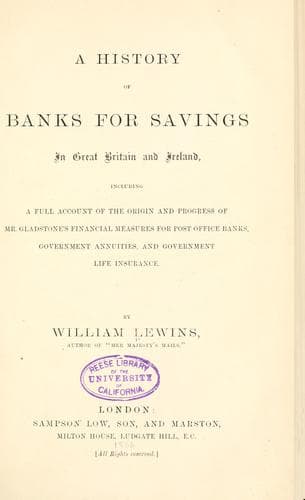
A History of Banks for Savings in Great Britain and IrelandLewins, William
History
A History of Banks for Savings in Great Britain and Ireland
Lewins, William
Postal savings banks -- Great Britain; Savings banks -- Great Britain
The members ultimately appointed were the Chancellor of the Exchequer,
the ex-Chancellor, Mr. Herries, Sir George Clerk, Mr. P. Scrope, Sir
G. Y. Bullar, Mr. Ker Seymour, Marquis of Kildare, Mr. Adair, Mr. G.
Craig, Mr. W. Fagan, Mr. Bramston, Mr. J. A. Smith, Mr. H. Herbert,
Mr. Reynolds. This Committee sat thirteen days, and examined nine
witnesses, including several officials connected with the Cuffe Street
bank, Mr. Tidd Pratt, Mr. Higham of the National Debt Office, and Mr.
Boodle of the St. Martin's Place Savings Bank, but came to no
conclusion, and recommended nothing to the House.
On the 13th of May, 1850, the same gentlemen were reappointed under
the self-same conditions as in the previous year: they sat eleven
days, and examined some of the same and other witnesses, and on this
occasion made a long and exhaustive report to the House.[83] This
report, for which all the members except Mr. Reynolds and Mr. Herbert
voted (each of these gentlemen having produced a report of his own
which the Committee would not accept), went over the case of the
defaulting Savings Bank in Dublin very succinctly; exonerated National
Debt Commissioners and their officers from blame; stated that they
found the commissioners did not exercise all the powers they
possessed, but this arose "partly from a misgiving as to the effect of
an exercise of their authority, and partly from an unwillingness to
run the risk of creating a discredit of these institutions;" and that
if the trustees had taken the advice of the commissioners, when in
1845 they advised them to close the bank, the loss to the depositors
would not have exceeded five shillings in the pound. For these and
similar reasons the Committee came to the weighty conclusion, relative
to this particular case of fraud, that "while they cannot admit the
existence of any legal liability on the part of Her Majesty's
Government, they recommend the case of the depositors in the Cuffe
Street bank to the favourable consideration of the Government, with a
view to the adoption of some measure which shall at least mitigate the
extent of their loss." With regard to the other frauds into which they
were instructed to inquire, they reported that there were "no peculiar
features connected with them differing from those of other banks which
have suffered from the dishonesty of their actuaries." They concluded
by expressing their conviction of the unsatisfactory state and working
of the existing law; proper power did not reside with any authority
"to check abuses, however indisputable;" by expressing their opinion
that the provisions of the law of 1844 had worked in a manner
obviously at variance with the intentions of Parliament, and wound up
by the following important paragraph:--
Public-domain text, read in full here on John Shaqi.
Reviews
Reviews
No reviews yet
Be the first to share your thoughts on this work.
Elsewhere in the archive
Join the Discussion
Join the discussion
Sign in to leave a comment or review.
Sign InorCreate an account