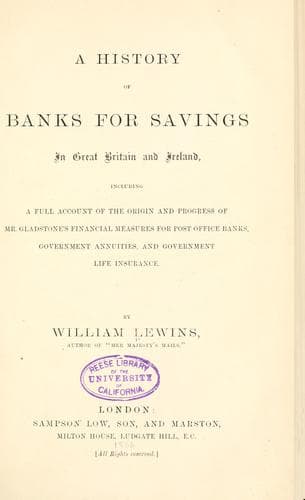
A History of Banks for Savings in Great Britain and IrelandLewins, William
History
A History of Banks for Savings in Great Britain and Ireland
Lewins, William
Postal savings banks -- Great Britain; Savings banks -- Great Britain
"Your Committee have observed with much satisfaction that
the Chancellor of the Exchequer has introduced a Savings
Banks bill, which is calculated to remedy several
important defects in the existing law, and extends the
responsibility of Her Majesty's Government to the
depositors; and they therefore abstain from all
observations on this part of the subject, further than to
state the conviction, which this inquiry has forced upon
them, of the urgent necessity for further legislation, if
those institutions, which have of late years acquired an
extent and importance so little anticipated by the
original founders of Savings Banks, are to preserve their
hold on the confidence of the country, or produce the
beneficial results expected from them in encouraging and
rewarding the industry and self-denial of the working
classes."
This report was presented to the House on the 1st of August, and at
once referred to a Committee of the whole House. Next day, the
Chancellor of the Exchequer proposed that a grant of 30,000_l._ should
be made to the defrauded depositors in the Cuffe Street bank, out of
the Consolidated Fund. _Sir James Graham_ opposed the grant. If this
money was a matter of charity, he argued, they were opening the door
to a dangerous principle; if of justice or equity, the claim ought to
be paid in full. It was unworthy of the British public to compromise
for ten shillings in the pound. Other members asserted that if Cuffe
Street depositors were paid, the poor creditors of other insolvent
banks would likewise have to be paid. Generally, however, the House
felt with the Committee; it was altogether an exceptional case, the
claims of the former being, as Sir Charles Wood expressed it,
"something between equity, sympathy, and charity." _Mr. Bright_, a
resident of Rochdale, and _Mr. Sharman Crawford_, the member for that
borough, whose ears had lately rung with the tales of heartless
deception practised there, were both for paying these depositors in
full; "there might be no legal claim, but there were the claims of
equity and morality." Mr. Bright, indeed, went so far as to say, that
if Government would bring in a bill to secure other banks in future
from these dreadful calamities, he would willingly vote that all
claims from Savings Bank failures should at once be met by the State.
The House divided on Sir Charles Wood's motion, when 118 members voted
for it, and 39 against it. We may as well say here that several
attempts were subsequently made to get the remaining 30,000_l._ from
Government, but without avail.[84]
Public-domain text, read in full here on John Shaqi.
Reviews
Reviews
No reviews yet
Be the first to share your thoughts on this work.
Elsewhere in the archive
Join the Discussion
Join the discussion
Sign in to leave a comment or review.
Sign InorCreate an account