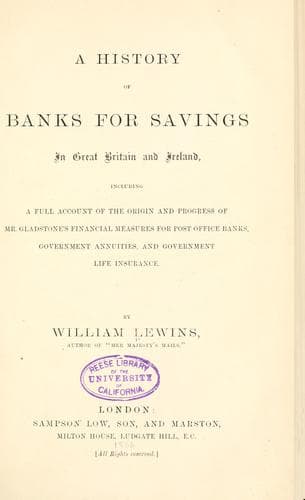
A History of Banks for Savings in Great Britain and IrelandLewins, William
History
A History of Banks for Savings in Great Britain and Ireland
Lewins, William
Postal savings banks -- Great Britain; Savings banks -- Great Britain
It will not be difficult for the reader to understand the position of
affairs up to 1850. The law was clearly unsatisfactory; it had been
pronounced so by Committees which, though composed of nearly the same
members, had sat in three successive years, and patiently examined
into the question in its every detail. The only difference of opinion
indeed in the Committees was, as to the persons who were liable, and
to what extent, for the defective state of the law, and the results to
which it had led. Nor is it at all wonderful that legislation should
have been needed. Savings Banks, as it was often pointed out about the
time, had increased enormously within a short period, and beyond all
proportion to the expectations which were originally formed with
regard to them. When they were first started, many benevolent
individuals entered heartily into the work of managing them, and asked
for no return, except the sense that they had assisted in a humane and
praiseworthy object, for the labour they underwent. Putting two
considerations together--the great increase of business, and the no
less certain decrease in the first ardour attending such
enterprises--the increase of paid officials became absolutely
necessary, and in almost a corresponding ratio did the unpaid
machinery decline. Slowly but surely the management of Savings Banks
went out of the hands of an unpaid into those of a paid staff of
officials, and every year the system of check became more nominal than
real.[85] It was apparent, not less from the proceedings of solvent
Savings Banks than from the exposures made in the case of unsound
ones, that those who had originally taken part in the establishment of
these institutions slowly became honorary in place of active members
of the board; and of those who still continued to take a share in the
work, many had got into the habit of leaving their duties to
subordinates, in some cases signing blank forms, and even cheques, to
be filled up by the acting-manager at his discretion.
Public-domain text, read in full here on John Shaqi.
Reviews
Reviews
No reviews yet
Be the first to share your thoughts on this work.
Elsewhere in the archive
Join the Discussion
Join the discussion
Sign in to leave a comment or review.
Sign InorCreate an account