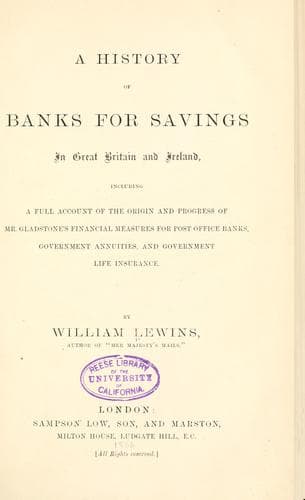
A History of Banks for Savings in Great Britain and IrelandLewins, William
History
A History of Banks for Savings in Great Britain and Ireland
Lewins, William
Postal savings banks -- Great Britain; Savings banks -- Great Britain
At this stage in the history of Savings Banks, the Chancellor of the
Exchequer came forward,--as the reader has already learnt from the
Report of the Committee of 1850,--with a bill to amend the law. This
bill he introduced to the House of Commons on the 29th of April, 1850,
and it forms part of our object to explain in detail the plan now
proposed, inasmuch as for many subsequent years the same measure, with
only trifling modifications, was offered over and over again to the
consideration of the House, and as often declined, through the
overpowering influence of the Savings Bank interest in the country. On
bringing forward his bill, the Chancellor said he wished to avoid all
reference to the past, except in as far as the experience of the past
was a guide to future legislation. He very briefly traced the history
and progress of Savings Banks, remarking at the time that, if he were
not to do so, few could be aware of their real nature, and how they
had grown to their present dimensions. We need not follow Sir Charles
Wood through this account, nor even repeat the reasons which actuated
the Legislature in making changes in the law from time to time up to
the year 1844. Referring to the Act of that session, he described it
as "most defective," and the bill he wished to introduce would amend
it. Speaking of the responsibility as to loss in Savings Banks, which
many persons thought should rest with the Government, he repudiated
the notion, unless Government was allowed to have some control over
the persons who might occasion the loss. On the other hand, he did not
wish to do away with "the most invaluable feature in Savings
Banks--the local management." He thought, however, that Government
might take a medium course, and fairly meet the case by making such
arrangements as "would end in the State bearing nearly the whole
responsibility as regarded the receipt and payment of money." What he
proposed was to alter the enactment that the treasurers of Savings
Banks should receive no emolument, _and to vest the appointment of
Treasurer in the hands of the Commissioners for the Reduction of the
National Debt_. The existing treasurers might in most cases be
continued, and if they wished to work for nothing, they might still
have the option; but he insisted on the Government reappointing such
officers, and upon having a control over them. To this officer, or
some one acting for him, all payments should be made over--the receipt
and payment of money by any other person to be declared illegal.[86]
He considered that this arrangement would guard against the
possibility of fraud. The treasurer and secretary, acting for
different interests, as it were, could scarcely be guilty of
collusion, and the one would in all cases act as a check upon the
other. If this plan were agreed to, the Government would of course be
responsible for every farthing paid to the treasurer.
Public-domain text, read in full here on John Shaqi.
Reviews
Reviews
No reviews yet
Be the first to share your thoughts on this work.
Elsewhere in the archive
Join the Discussion
Join the discussion
Sign in to leave a comment or review.
Sign InorCreate an account