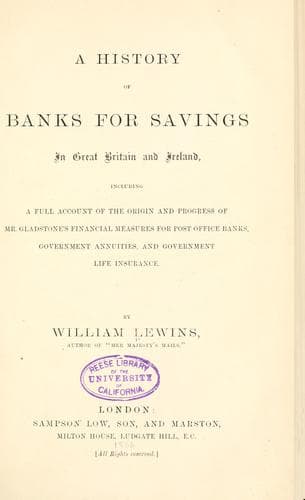
A History of Banks for Savings in Great Britain and IrelandLewins, William
History
A History of Banks for Savings in Great Britain and Ireland
Lewins, William
Postal savings banks -- Great Britain; Savings banks -- Great Britain
That Savings Bank money was not only used for financial purposes, but
turned to extremely profitable use, there can be no doubt: hence
complaints of loss could only be made by persons but partially
acquainted with the facts. Mr. Hume indeed, had he been cognizant of
the profitable way the funds were used, could scarcely have complained
about the loss to the State so often as he did. Mr. Gladstone at this
time, and subsequently, never missed an opportunity of putting the
matter on the proper footing, and to set it forth that, instead of a
loss, the funds had been a source of considerable gain to the State.
In 1834, when Lord Althorp was Chancellor of the Exchequer, and Lord
Monteagle himself (as Mr. Spring Rice) Secretary of the Treasury, they
determined to reduce the interest on the Four per Cents. Those who
held money in the Funds and were dissatisfied with the reduction were
paid off out of the Savings Bank money (without which, indeed, the
reduction could not have been earned through), and a saving to the
country of 53,000_l_. a year was the result. Mr. Goulburn, using the
power he had in the same way, or with the money of Savings Banks to
fall back upon in case of need, effected a saving of 750,000_l._ a
year in reducing the rate of interest from four to three and a half,
then to three and a quarter, and eventually to three, per cent. Not
less useful were the funds of Savings Banks in the time of the Crimean
War. By means of Ways and Means bills, the Chancellor of the Exchequer
raised the necessary funds to meet the heavy demands, and thus
effected an enormous saving of money, which would have been sunk in
transacting a loan.
Public-domain text, read in full here on John Shaqi.
Reviews
Reviews
No reviews yet
Be the first to share your thoughts on this work.
Elsewhere in the archive
Join the Discussion
Join the discussion
Sign in to leave a comment or review.
Sign InorCreate an account