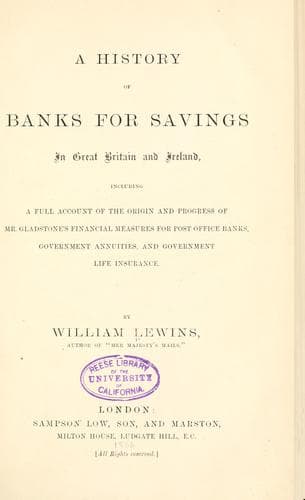
A History of Banks for Savings in Great Britain and IrelandLewins, William
History
A History of Banks for Savings in Great Britain and Ireland
Lewins, William
Postal savings banks -- Great Britain; Savings banks -- Great Britain
money than there was in the bank, I went to Mr. Lynch, and said there
must be some mistake somewhere, and told them to stop taking in any
more money till it was cleared up. The next day Mr. Lynch being ill in
bed, sent for me, and made a confession that he had committed frauds;
but he stated no amount. I then seized his books and papers and
everything I found connected with the bank, and swore information as
to the facts." The books were then subjected to a thorough
examination, and "frauds of every possible character," to the extent
of 36,000_l._, were found to have been committed. At the trial which
ensued, Lynch pleaded guilty, and was sentenced to fourteen years'
transportation.
The other modes of enriching himself to which we have not yet referred
may be given in Lynch's own words. Soon after his apprehension he made
a confession of his malpractices, in order to exonerate a clerk of the
bank who had been arrested at the same time, and who was at first
thought to be an accomplice, and we take the man's own account of his
ingenious trafficking in forged pass-books as the most lucid one that
could possibly be given. "A depositor lodged money with me," said the
actuary; "I entered it in the pass-book, but not in the receipt-book.
He subsequently lodged more, say with Mr. Fitzgerald, and it was duly
entered in the pass-book and the receipt-book. For these depositors
there necessarily was no account to be found in the bank books, and
the party paying him upon notice given would thus be presumptively
implicated." He proceeded to give another instance of his artifice: "I
frequently took an old pass-book and tore out the _bonâ fide_ deposit
leaf; I made an entry therein in a fictitious name, and a _quasi_
deposit, as if it were some years antecedent. During bank hours I used
to hand in those books to whoever might be in the bank, directing
notice to be given for the amount, as though the depositor had left it
with me for that purpose, as it were, some days antecedently. The
manager entering such notice was thus presumptively implicated; and as
the course of the bank unfortunately was to 'keep' and not relodge
sums 'noticed for,' the manager of the day marked it as 'kept,' which
meant, given to me to give to the _quasi_ depositor." "Kept!" What a
fund of irony there is in that one word so applied! In one or other of
the modes described, this actuary, "respected by all who knew him,"
contrived to "keep," and, what is worse, to spend, 36,000_l_. of the
hard-earned savings of the poorest classes around him. His estate at
the time of his apprehension was worth something like 3,000_l_.; this
property Lynch offered to give up in full, "leaving not even a bed for
his daughter;" but on Mr. Pratt's being applied to for advice, that
gentleman recommended the treasurer not to fall in with the offer,
inasmuch as it would be "a compounding of the felony." (825.)[119] Mr.
Pratt had arrived by this time at Tralee, and was engaged in the
Public-domain text, read in full here on John Shaqi.
Reviews
Reviews
No reviews yet
Be the first to share your thoughts on this work.
Elsewhere in the archive
Join the Discussion
Join the discussion
Sign in to leave a comment or review.
Sign InorCreate an account