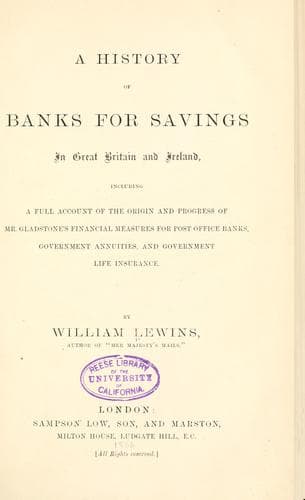
A History of Banks for Savings in Great Britain and IrelandLewins, William
History
A History of Banks for Savings in Great Britain and Ireland
Lewins, William
Postal savings banks -- Great Britain; Savings banks -- Great Britain
Mr. Duncan's work was far from completed when even his most sanguine
expectations were realized in the progress of the Ruthwell Bank. His
advice and assistance was now continually sought in aid of the
formation of similar institutions, both in Scotland and England. In
1813, "the Edinburgh Society for the Suppression of Beggars" conceived
the idea of adding to their already extensive operations a Savings
Bank on some similar principle to his. A neighbour of Mr. Duncan's,
who was also a member of the Edinburgh society, communicated a full
account of the Ruthwell Bank, and all the accounts of it which had up
to that time been published. The opening of the Edinburgh Bank, of
which we shall presently speak more at length, took place in 1814. In
1814, Mr. Duncan paid a long promised visit to Kelso, in order to
forward the proposals for a Savings Bank at that place. Mr. Duncan
relates[21] that during his journey to Kelso he passed through the
town of Hawick, and was much gratified to find that his scheme was
freely talked of there. In the shop of one of the booksellers of the
town he found a large number of copies of an account of the Ruthwell
Bank wet from the press, which had been taken from the pages of the
_Dumfries Courier_ and supplied by himself. These handbills, which
likewise gave a copy of the Rules of the Parish Bank, had been printed
by order of the magistrates of the county at their ordinary meeting.
Finding that his scheme had many favourers in Hawick, he promised to
call on his journey home and assist them in the formation of a bank.
On his arrival at Kelso an important meeting was held, with the Duke
of Roxburgh in the chair, when Mr. Duncan addressed the meeting; the
Kelso Savings Bank, one of the most important of the Scotch
institutions, being the direct result. The number of letters which Mr.
Duncan received and wrote per day is described as something enormous;
they arrived by every post, not only from his own and the sister
country, but even from Ireland. Not only did these letters contain
requests for information and advice; but they frequently were of a
controversial nature, and generally from such people, ardent friends
of the poor, as required consideration and some reply. That Duncan was
an agreeable and clever correspondent is evident from his published
letters; that this correspondence was voluminous we can well believe.
With a view of lessening the amount of his labours in this respect, he
was induced to publish a full account of his scheme, together with all
the rules and regulations for its working; and this pamphlet, which
came out in 1814, went through three editions very rapidly. Even at
this date Duncan's "Essay on the Nature and Advantages of Parish
Banks" will well repay perusal, and besides, its intrinsic worth as a
literary production is interesting as the first published pamphlet on
a subject which will always possess attractions to the philanthropist,
if to none else. We have the clearest evidence that Mr.
Public-domain text, read in full here on John Shaqi.
Reviews
Reviews
No reviews yet
Be the first to share your thoughts on this work.
Join the Discussion
Join the discussion
Sign in to leave a comment or review.
Sign InorCreate an account