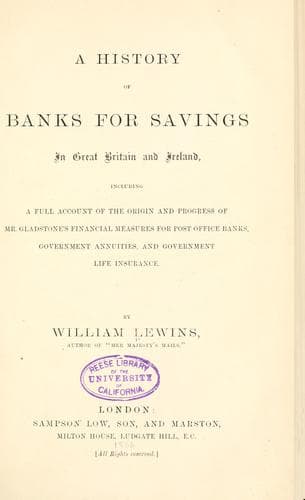
A History of Banks for Savings in Great Britain and Ireland — John Shaqi
A History of Banks for Savings in Great Britain and IrelandLewins, William
History
A History of Banks for Savings in Great Britain and Ireland
Lewins, William
Postal savings banks -- Great Britain; Savings banks -- Great Britain
Duncan
laboured with uncommon zeal to spread a knowledge of the plans he
proposed, and to help to their general introduction; and it is a
matter of wonder to us, that, whilst many names are familiar to the
world who did not do a tithe of the real hard work he did to benefit
the poor around him, Duncan's name should be for all essential
purposes really unknown, and that but for the filial regard of his
son, scarcely an account of his existence should have survived
him.[22] Speaking during his life time, the _Quarterly Review_ warmly
noticed his labours of love: "Justice leads us to say that we have
seldom heard of a private individual in a retired sphere, with
numerous avocations and a narrow income, who has sacrificed so much
ease, expense, and time, for an object purely disinterested, as Mr.
Duncan has done." Some years before his death, in 1846, Mr. Duncan
attained to the honorary degree of Doctor of Divinity, and he was for
one year chosen Moderator of the Assembly of the church to which he
belonged. The Duncan Institution at Dumfries, one of the few mementos
of the man who did so much for Savings Banks, serves the purposes of a
Savings Bank in the principal town of his native county, a statue of
Dr. Duncan being very appropriately placed in front of it.
Not long after the establishment of the Edinburgh Savings Bank, there
was great contention as to whether that bank or Dr. Duncan's at
Ruthwell had the priority of merit on the score of general advantage.
Pamphlets were written on the subject, not always without bitterness,
and even the great _Reviews_ interfered. The dispute was scarcely
called for at that early period, seeing that posterity is best able to
judge of such matters, and there was nothing dependent upon an earlier
settlement. The Edinburgh bank followed the village bank by three and
a half years, so it was not a claim for priority of establishment. The
question as to which of the two possessed the materials best fitting
it to be a model for all subsequent banks would not be so easily
settled; and, in fact, this was the point in dispute. Seeing the
question was one of considerable importance for many years, and is so
still in an archaic point of view, we cannot do better than attempt to
give some idea of the difference between them, as gathered from the
two accounts now before us.[23] Unquestionably the arrangements of Mr.
Duncan suffer considerably by a comparison of points, and though we
admire the character and arduous labours of the man, there is not the
slightest need that we should abstain from hostile criticism of his
measures. For example, Mr. Duncan laid great stress on the fact of his
bank being the first self-sustaining bank, and the first not partaking
to any extent of the nature of a charity. It will be seen how far this
was absolutely true. The Ruthwell institution consisted of ordinary,
extraordinary, and honorary members. The ordinary members were the
Public-domain text, read in full here on John Shaqi.
Reviews
Reviews
No reviews yet
Be the first to share your thoughts on this work.
Join the Discussion
Join the discussion
Sign in to leave a comment or review.
Sign InorCreate an account