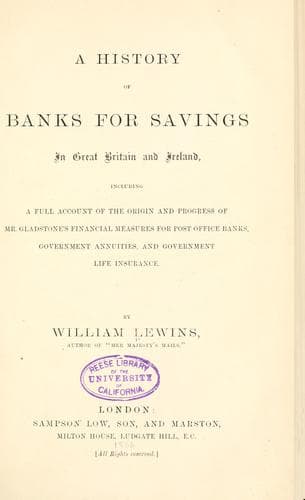
A History of Banks for Savings in Great Britain and IrelandLewins, William
History
A History of Banks for Savings in Great Britain and Ireland
Lewins, William
Postal savings banks -- Great Britain; Savings banks -- Great Britain
to us, most irksome, and no less to the poor than to the rich. The
arrangement by which various rates of interest were given to different
classes of depositors, according to their good or indifferent
characters, was eminently arbitrary, if not unfair.
We have already alluded to the Edinburgh Savings Bank, instituted
after the parent bank at Ruthwell, and to some extent upon its model;
the offspring, however, in many points presented a happy contrast to
the Ruthwell Bank, in the simplicity and greater fairness with which
its affairs were managed. As it is now a matter beyond doubt that many
banks formed subsequently were started on the model of the Edinburgh
institution, a few words of description of its principal new features
may not be out of place. All depositors were paid the same rate of
interest; they deposited their savings without any preliminary
investigation of any sort; and whilst the management was not left,
even in part, to the classes it was designed to benefit, contributors
had nothing to do but pay in such sums as suited them, and withdraw at
pleasure, altogether as the classes above them would deal in the
ordinary bank. From the pamphlet published in the same year as that of
Dr. Duncan's, and to which we have already alluded, we are enabled to
give some account of the plan of working in the Edinburgh Bank; and it
is very interesting at this distant period to see how nearly identical
with the modern Savings Bank this early one was, or rather, we think
we ought to say, how closely the example of the Edinburgh Bank has
been followed. The bank, we find, was open every Monday morning
between nine and ten o'clock. No less sum than one shilling could be
received. The uniform interest paid was at the rate of four per
cent.[26] The money might be paid back at any time on a mere demand
and production by the depositor of his _deposit sheet_. Each depositor
was furnished, on making his deposit, with a duplicate of the _leaf of
the ledger_ in which his account was kept; on each succeeding visit he
brought the duplicate with him, and each separate transaction was
entered in the ledger and on the duplicate at the same time. This
arrangement, as might have been expected, soon gave place to the more
convenient bank-book at present in use. It will be observed that up to
this time, and some years subsequently, the Savings Banks had no
connexion with Government, and the funds realized were accordingly
deposited with some banking company, and, as a rule, the interest
received was at a higher rate than has since obtained. One feature in
the Edinburgh Bank, as in other Scotch banks of the period, is unknown
at present. When the deposits of any one person amounted to ten pounds
(the minimum sum received by an ordinary bank), he was presented with
an interest-note upon any banking firm he chose to name for the
amount. Henceforth he held an account with the bank in question,
receiving a higher rate of interest, and a strengthened security for
his money.
Public-domain text, read in full here on John Shaqi.
Reviews
Reviews
No reviews yet
Be the first to share your thoughts on this work.
Join the Discussion
Join the discussion
Sign in to leave a comment or review.
Sign InorCreate an account