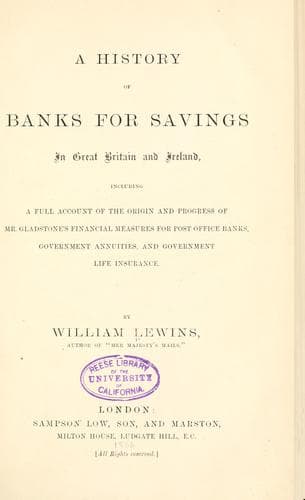
A History of Banks for Savings in Great Britain and Ireland — John Shaqi
A History of Banks for Savings in Great Britain and IrelandLewins, William
History
A History of Banks for Savings in Great Britain and Ireland
Lewins, William
Postal savings banks -- Great Britain; Savings banks -- Great Britain
a climax, as it were, upon this charitable disposition of a man's own
hard-earned savings, we would merely recite the fifth statute, which
directs that "when the depositor shall have become incapable of
maintaining himself, from sickness or otherwise, a weekly allowance
may be made to him, _at the option of the Court of Directors_, out of
the money he has deposited."
The auxiliary fund, to which the honorary and extraordinary directors
were required to contribute, was employed in awarding premiums to
those who were most regular with their deposits, especially to those
regular depositors who should have exhibited proofs of superior
industry or virtue. It may well be thought that, in such delicate
matters as were thus dealt with, differences of opinion would arise,
so it was wisely provided, that any aggrieved member should have the
power of appeal from the Court of Directors to the Standing Committee,
and from the Standing Committee to a General Meeting, whose decision
should be final. "The example set by Dr. Duncan at Ruthwell," says Mr.
Smiles,[25] "was shortly followed in many other parishes in Scotland,
and in most of the principal towns in England," and, so far, we have
seen this is true. What follows is certainly open to question: "In
every instance, the model of the Ruthwell Bank was followed, and the
vital, self-sustaining principle was adopted. The Savings Banks were
not eleemosynary institutions, nor dependent upon anybody's charity or
patronage; but their success rested entirely with the depositors." Our
readers may judge from the details of management which we have given
how far this is borne out by the facts of the case; for ourselves, we
are slow to take from the merit which undoubtedly should attach to Dr.
Duncan. There were, doubtless, many circumstances connected with the
minister's own parish which made the arrangements to which we have
referred more excusable; but there must have been many districts where
the poor would never suffer themselves to be patronized, petted, or
provoked in the same manner. Hence the inapplicability of the details
to the country generally. Real, honest, independent workmen have
always had a great dislike to be experimented upon, "raised," or
"elevated," in the sense that some men use the terms; what was felt to
be required at this early period was, that there should be afforded
some facility for the depositing, without any unnecessary trouble or
annoyance, such small sums as the poor might have to spare, and wish
to save; and that this money should not only be safe, but produce
interest according to its value in the market, and neither more nor
less. That arrangements made with this laudable object should be
accompanied with others which should have the tendency, however
remote, to disgust and repel the poor, was unfortunate, to say the
least. Any interference with, or superintendence over the family
affairs or the private conduct of members, was likely to be, it seems
Public-domain text, read in full here on John Shaqi.
Reviews
Reviews
No reviews yet
Be the first to share your thoughts on this work.
Join the Discussion
Join the discussion
Sign in to leave a comment or review.
Sign InorCreate an account