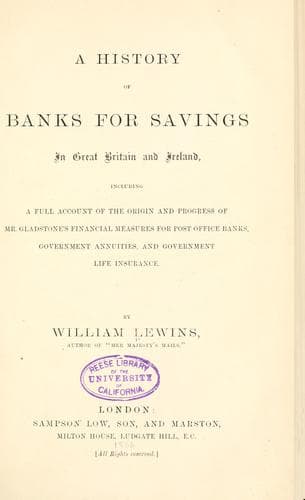
A History of Banks for Savings in Great Britain and IrelandLewins, William
History
A History of Banks for Savings in Great Britain and Ireland
Lewins, William
Postal savings banks -- Great Britain; Savings banks -- Great Britain
Before we notice the further progress of legislation in respect to
Savings Banks, it would be well to refer to their progress and
operation in Scotland. None of the Acts passed up to this time in any
way related to the Scotch banks. When Mr. Rose's bill was before
Parliament, its application to Scotland was successfully opposed; a
separate bill was introduced by Mr. Douglas, the member for the
Dumfries burghs, in 1818, but this did not pass. The failure to obtain
this act was said to be owing exclusively to the necessity for
legislative interference not being felt in Scotland; it seems now much
more likely that the failure was owing to the want of unanimity among
the Scotch promoters of Savings Banks, Mr. Duncan taking a decided
stand with the member whom he had influenced so far as to get him to
bring in a bill, and the promoters of the Edinburgh bank, on the other
hand, who kept up in this way the long-standing dispute which they had
always had with "the Father of Savings Banks."[32] There was certainly
some reason why the same legislation was unnecessary for the two
countries. There were many circumstances which rendered interference
on the part of the Legislature necessary, or at least expedient, in
the case of the English banks, and these circumstances scarcely in any
way applied to Scotland. The chief of these were the Poor Laws, and
the want of secure places of deposit for small sums to bear interest,
and be payable on demand; the English bankers did not usually allow
interest on money lodged with them, whereas in Scotland they gave a
liberal return for it. The general dispute was at its height in 1819,
when the Edinburgh Society published a report against any State
interference, and when Mr. Duncan, who, as we have already said, was a
strong advocate for parliamentary encouragement and protection,
replied in a lengthy and able letter,[33] in which he clearly showed
that difficulties and discouragements would surely be felt in the
progress of Savings Banks, if they were not arranged according to law.
The radical difference observable in the two classes of banks--and
there were at this time 182 Savings Banks in Scotland with 7,000
depositors, and deposits to the amount of 30,000_l._--was the
difference between the Parish Bank at Ruthwell, and the Savings Bank
at Edinburgh, for on one or other of these models all the Scotch banks
were with very few variations formed. Mr. Duncan placed, or intended
to do so, the management of his bank in the hands of the whole body of
depositors; the Edinburgh bank excluded all popular interference in
its management, and left every one to deal with it or not, at their
pleasure. The Ruthwell bank confessedly, and as we have seen, partook
of the nature of a Friendly Society; the Edinburgh bank as nearly as
possible approached to the character of a commercial undertaking. The
founder of the former was thus an advocate for minute regulations,
Public-domain text, read in full here on John Shaqi.
Reviews
Reviews
No reviews yet
Be the first to share your thoughts on this work.
Join the Discussion
Join the discussion
Sign in to leave a comment or review.
Sign InorCreate an account