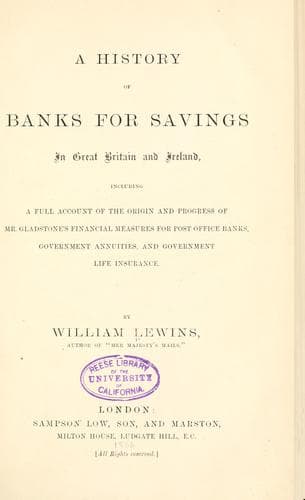
A History of Banks for Savings in Great Britain and IrelandLewins, William
History
A History of Banks for Savings in Great Britain and Ireland
Lewins, William
Postal savings banks -- Great Britain; Savings banks -- Great Britain
while the patrons of the latter wished to be left at liberty to manage
their affairs in their own way, and only to call in the help of the
Legislature when real grievances needed redressing.
With the exception of a short Act[34] passed in 1820, by which it was
provided that charitable institutions might deposit a whole or a
portion of their funds with the Commissioners, no further legislation
on Savings Banks was attempted till 1824. In this year the Chancellor
of the Exchequer (Mr. Robinson) took up the matter where Mr.
Vansittart had left it, and carried a Bill through Parliament still
further to amend the law.[35] With a view to remedy still more
completely the evil of classes, other than the industrious ones,
investing their money in Savings Banks, this Act provided that the sum
which could be deposited during the first year should be limited to
50_l._ and should stand at 30_l._ for any succeeding year. To provide
against anything like evasion of these regulations, a form of
declaration was introduced,--which we scarcely need say has existed up
to the present time,--stating that the subscriber to it had not
contributed to any other bank than the one at which he made the
declaration. The Chancellor of the Exchequer endeavoured to carry a
clause which required that this declaration should be subscribed by
the proposed depositor in his own name, "and own handwriting," in
place of a mark or initials, but this was wisely discarded. This
absurd proviso would have put an educational test in the way of those
very classes whom, to the exclusion of all others, it was desirable to
attract to Savings Banks. Another important clause succeeded better,
and was plainly proper to the object meant to be served by it. No
depositor could by this further clause invest more than 200_l._
excluding interest, in any Savings Bank. The case of the funds of
Friendly Societies was the subject of another clause. It was only four
years since these societies, as we have seen, were allowed to deposit
their funds through the medium of Savings Banks; but the Act of 1820
had given rise to so much abuse, or to so much that seemed like abuse,
that some alteration was necessary. The high rate of interest which
had been guaranteed by law to these banks induced, not only
individuals of rank and property, but large charities to place their
funds in them: the result was a great burthen to the public, inasmuch
as the excess over the ordinary rate of interest for public securities
was thrown in by the Legislature with the object of increasing the
provident disposition of the poor. As it was seen that, if this state
of things continued, the original object of State assistance and
countenance to Savings Banks would be defeated and the public in some
degree prejudiced, it was proposed that no friendly society or
charitable institution of any kind should deposit their funds in any
bank. If the alterations now proposed did not suffice to preserve
Public-domain text, read in full here on John Shaqi.
Reviews
Reviews
No reviews yet
Be the first to share your thoughts on this work.
Join the Discussion
Join the discussion
Sign in to leave a comment or review.
Sign InorCreate an account