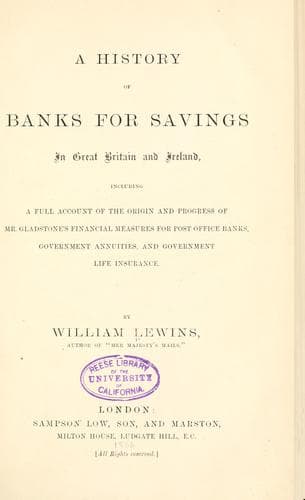
A History of Banks for Savings in Great Britain and IrelandLewins, William
History
A History of Banks for Savings in Great Britain and Ireland
Lewins, William
Postal savings banks -- Great Britain; Savings banks -- Great Britain
Early in February, 1828, _Mr. Joseph Hume_--who had not then been many
years in Parliament, but who had already commenced that course of
conduct in connexion with the public expenditure which, at first,
gained him little but ridicule and derision, and subsequently the
respect of friend and foe and the confidence of the entire
nation--took up the question of Savings Banks, or more especially that
part of it which related to the question of expense to the Government.
Mr. Hume had already asked for returns of the progress of Savings
Banks; but on the 6th of this month he required the production of an
account, showing the amount of interest that had been allowed to them
since they had become connected with the State in 1817. He tried to
disabuse the mind of the members of the House as to his having any
prejudice against Savings Banks. He told how he had been one of the
earliest friends of these institutions and heartily wished well to
them. When he found, however, that they had already cost the country
half a million sterling, and were likely to cost still more as their
numbers and efficiency increased, he thought it was high time to have
the matter inquired into, and this expenditure stopped. Mr. Hume said
that his original notion about Savings Banks,--which was likewise that
of all he knew who had endeavoured to establish them,--was that each
bank might, and therefore ought to maintain itself, and, whilst it
enabled the poor to invest safely their 10_l._ or 20_l._ as cheaply
and as profitably as the rich could their larger amounts, it should
neither be a burthen on the charity of the benevolent nor an incubus
on the State. Mr. Hume stated that he believed it would be found that
up to January, 1827, the amount paid to Trustees, over and above what
the money remitted to the National Debt Commissioners had produced,
was 452,000_l._ By the arrangement of the Act of 1817, which ordered
that a separate account should be kept of the moneys deposited with
Government on behalf of Savings Banks, he was enabled to tell exactly
how affairs stood. He found that Government had obtained interest on
the Savings Bank Fund to the extent, in round numbers, of
2,250,000_l._ and had paid to depositors for the same 2,703,000_l._
Hence the loss[36] above given, which he had no doubt by the time the
accounts were finally made up for the financial year ending in March
would be half a million sterling. Mr. Hume went on to state that, if
honourable members thought it proper after an inquiry to pay
40,000_l._ or 50,000_l._ a year, as a means of encouraging these
banks, let them do so; perhaps he would not make any more appeals
about it; at any rate, however, in this case, and if this state of
things continued, he thought it would be only fair that Government,
and not separate directors, should have the management and control of
these banks. There was no possible uniformity among them; some paid
one rate of interest, and some another; some charged much higher for
Public-domain text, read in full here on John Shaqi.
Reviews
Reviews
No reviews yet
Be the first to share your thoughts on this work.
Join the Discussion
Join the discussion
Sign in to leave a comment or review.
Sign InorCreate an account