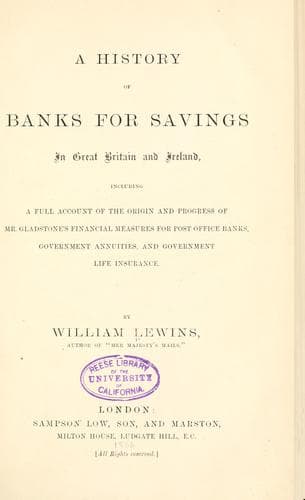
A History of Banks for Savings in Great Britain and IrelandLewins, William
History
A History of Banks for Savings in Great Britain and Ireland
Lewins, William
Postal savings banks -- Great Britain; Savings banks -- Great Britain
Savings Banks from the inroads of the rich, the Chancellor of the
Exchequer saw no other means of meeting the evil than by reducing the
interest given. He "should feel most reluctant to weaken the
confidence which the public reposed in these banks, and which rendered
them one of the greatest blessings ever conferred upon the country;"
but the evil must be met in one way or the other, or with the loss of
their normal character they would lose their efficiency.
The Act of Amendment then went on to deal with the responsibility of
Trustees, the giant difficulty of Savings Banks from that time until
now. The same arguments were used at this early period as at different
times subsequently. Those who placed money in Savings Banks ought to
have some security that that money was not made away with by some one
through whose hands it would pass; and the Trustees, who had the sole
control over the affairs of the banks, and appointed all the
subordinate officers, were the persons who ought to give some
security. On the other hand, enforce to the full the liability of
Trustees, and the most able persons would be deterred from accepting
so much responsibility, and would give up the connexion which they had
already voluntarily assumed. It was now therefore settled that the
Trustees should deposit all the money they received with the National
Debt Commissioners, and that they should be held liable in case of
default only to a certain amount. A legally and efficiently
constituted bank should consist of twelve Trustees, each liable for
50_l._, or 600_l._ in the aggregate. This Act, it was also decided,
should refer to Ireland equally as to England.
Public-domain text, read in full here on John Shaqi.
Reviews
Reviews
No reviews yet
Be the first to share your thoughts on this work.
Join the Discussion
Join the discussion
Sign in to leave a comment or review.
Sign InorCreate an account