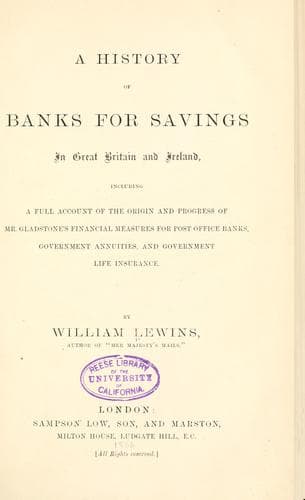
A History of Banks for Savings in Great Britain and IrelandLewins, William
History
A History of Banks for Savings in Great Britain and Ireland
Lewins, William
Postal savings banks -- Great Britain; Savings banks -- Great Britain
We have alluded to the necessity which began to be felt for the mental
improvement of the adult population; still more important were the
steps taken from time to time to educate the children who are the old
people and the adults of the present day. The present century, among
many wonderful changes which it has witnessed, has seen a complete
revolution in the means of education for the masses. Many generations
since, Milton, with that clear mental vision which was in him like a
kind of second sight, foretold that a time would come when the bulk of
the people would get a better education "in extent and comprehension
far more large, and yet of time far shorter, and of attainment far
more certain, than hath yet been in practice;" and although we may not
have exactly reached the point prefigured by the poet-seer, some
marvellous strides have been taken during the present century. A
dramatist of Milton's own period makes a man of substance reply, in
answer to the query, "Can you read and write then?" "As most of you
gentlemen do, my bond has been taken with my mark at it."[2] At the
beginning of the present century little had been done for the
education of the masses. Grammar schools for the children of the
middle classes, and Free schools, as they were called, for an
infinitesimal fraction of the poor of our towns had been long
established, and, so far as they went, with certain enough results;
but, if we except the establishment of Sunday schools by Mr. Raikes of
Gloucester in 1783, nothing had been done for the educational wants of
the general poor. Malthus in his "Essay on Population," published
twenty years after this date, says, "It is surely a great national
disgrace that the education of the lower classes should be left merely
to a few Sunday schools supported by subscriptions from individuals,"
adding at the same time, that the country "lavished immense sums on
the poor which we have every reason to think have constantly tended to
aggravate their misery." "In their education," he goes on to say, "and
_in the circulation of those important political truths that most
nearly concern them_, which are perhaps the only means in our power of
really raising their condition, and of making them happier men and
more peaceable subjects, we have been miserably deficient." What the
state neglected, private enterprise took up; earnest men like Raikes
and Pounds, the working shoemaker, not only set an admirable example
in their own spheres of labour, but roused to action other men who
applied to the work greater powers of mind and the benefits of greater
system. Dr. Bell and Mr. Lancaster were two of these, who nearly at
the same time expounded their views of a general scheme for educating
the people; and who were strengthened in their opinion, as one of them
tells us, of its necessity, by the clamour of many who held that the
stability of our institutions was only sure so long as the people were
kept in ignorance. Mr.
Public-domain text, read in full here on John Shaqi.
Reviews
Reviews
No reviews yet
Be the first to share your thoughts on this work.
Join the Discussion
Join the discussion
Sign in to leave a comment or review.
Sign InorCreate an account