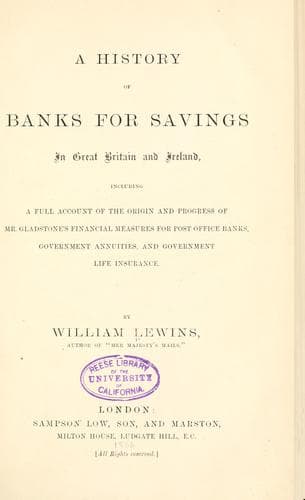
A History of Banks for Savings in Great Britain and IrelandLewins, William
History
A History of Banks for Savings in Great Britain and Ireland
Lewins, William
Postal savings banks -- Great Britain; Savings banks -- Great Britain
Whitbread, a statesman whose name was very
prominent about this time for efforts to promote the interests of the
bulk of the people, tried to induce Parliament at this stage to take
the subject into its consideration, by proposing a plan for the
establishment of parochial schools "for the exaltation of the
character of the labourer," and it would have been well if he had met
with more success. As it was, the sage legislators of the day, led on
by Mr. Windham, considered that such a plan would be very liable to
give an education to these classes much above their condition, and Mr.
Whitbread's scheme, like many other of his wise proposals to which we
shall have subsequently to allude, was set aside. The work, however,
had begun and could not be stopped by the attitude of the government.
Dr. Bell commenced his system by the establishment of National
schools; Mr. Lancaster, supported by Nonconformists principally, set
up Lancasterian schools. Although there was for some time much
hostility displayed between the rival factions, both organizations
struck deep into the dense masses of ignorance in our towns and
villages. Then came Government assistance, and gradually that system
of Government education and supervision which, in spite of many
objections to it, has been an untold blessing to the land.
Within the last thirty years the wise legislation of the Government
has had a direct influence on the progress of the people in education,
and in their social well-being. No more powerful aid, for example, was
given towards the triumph of enlightenment than the passing, in 1839,
of the penny postage measure, when thousands of the poorer classes
became emulous of each other in learning the rudiments of education,
so as to be enabled to possess themselves of the untold advantages of
this wonderfully successful scheme. Mr. Laing, the celebrated
traveller, after visiting the Continent, declared that the system of
penny postage was far more likely to cause the spread of education
among the masses than the Prussian system of education, if it came to
be adopted in this country. Only second to the repeal of the taxes on
correspondence was that of the reduction of the newspaper stamp duty,
and, still more recently, the abolition of the paper duty. The
relinquishment of these taxes redounds to the honour of those who took
part in the agitation for their abolition, and who held that no
artificial impediment, such as a paltry consideration of revenue,
ought to stand between the people and the free circulation of thought.
Lord Brougham said on one occasion that, "if newspapers, instead of
being sold for sixpence, could be sold for a penny, there would
immediately follow the greatest possible improvement in the tone and
temper of the political information of the people." Lord Campbell once
expressed a hope that newspapers would be sold for a halfpenny. Much
of this has been realized, and the result has been powerful for good.
Public-domain text, read in full here on John Shaqi.
Reviews
Reviews
No reviews yet
Be the first to share your thoughts on this work.
Join the Discussion
Join the discussion
Sign in to leave a comment or review.
Sign InorCreate an account