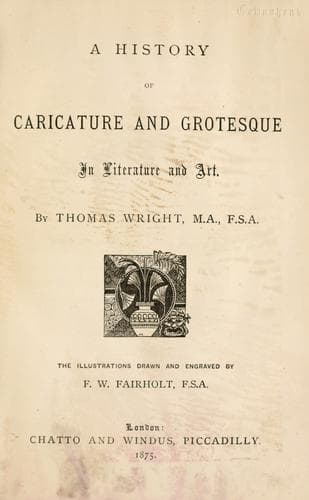
A History of Caricature and Grotesque in Literature and ArtWright, Thomas
History
A History of Caricature and Grotesque in Literature and Art
Wright, Thomas
Caricature -- History
The earliest known plays of this description in the English language
belong to the class which were called in France moralities. They are
three in number, and are preserved in a manuscript in the possession
of Mr. Hudson Gurney, which I have not seen, but which is said to be
of the reign of our king Henry VI. Several words and allusions in them
seem to me to show that they were translated, or adapted, from the
French. They contain exactly the same kind of allegorical personages.
The allegory itself is a simple one, and easily understood. In the
first, which is entitled the "Castle of Perseverance," the hero is
_Humanum Genus_ (Mankynd), for the names of the parts are all given in
Latin. On the birth of this personage, a good and a bad angel offer
themselves as his protectors and guides, and he chooses the latter, who
introduces him to _Mundus_ (the World), and to his friends, _Stultitia_
(Folly), and _Voluptas_ (Pleasure). These and some other personages
bring him under the influence of the seven deadly sins, and _Humanum
Genus_ takes for his bedfellow a lady named _Luxuria_. At length
_Confessio_ and _Pœnitentia_ succeed in reclaiming _Humanum Genus_,
and they conduct him for security to the Castle of Perseverance, where
the seven cardinal virtues attend upon him. He is besieged in this
castle by the seven deadly sins, who are led to the attack by Belial,
but are defeated. _Humanum Genus_ has now become aged, and is exposed
to the attacks of another assailant. This is _Avaritia_, who enters
the Castle stealthily by undermining the wall, and artfully persuades
_Humanum Genus_ to leave it. He thus comes again under the influence
of _Mundus_, until _Mors_ (Death) arrives, and the bad angel carries
off the victim to the domains of Satan. This, however, is not the end
of the piece. God appears, seated on His throne, and Mercy, Peace,
Justice, and Truth appear before Him, the two former pleading for,
and the latter against, _Humanum Genus_, who, after some discussion,
is saved. This allegorical picture of human life was, in one form or
other, a favourite subject of the moralisers. I may quote as examples
the interludes of "Lusty Juventus," reprinted in Hawkins's "Origin
of the English Drama," and the "Disobedient Child," and "Trial of
Treasure," reprinted by the Percy Society.
The second of the moralities ascribed to the reign of Henry VI., has
for its principal characters Mind, Will, and Understanding. These are
assailed by Lucifer, who succeeds in alluring them to vice, and they
change their modest raiment for the dress of gay gallants. Various
other characters are introduced in a similar strain of allegory, until
they are reclaimed by Wisdom. Mankind is again the principal personage
of the third of these moralities, and some of the other characters in
the play, such as Nought, New-guise, and Now-a-days, remind us of the
similar allegorical personages in the French moralities described above.
Public-domain text, read in full here on John Shaqi.
Reviews
Reviews
No reviews yet
Be the first to share your thoughts on this work.
Elsewhere in the archive
Join the Discussion
Join the discussion
Sign in to leave a comment or review.
Sign InorCreate an account