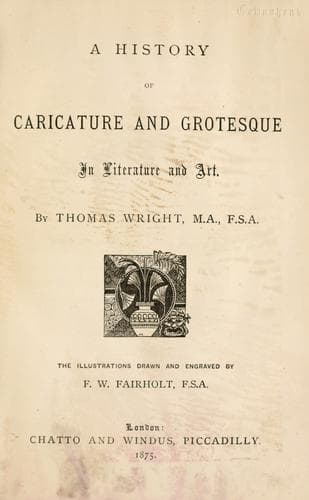
A History of Caricature and Grotesque in Literature and ArtWright, Thomas
History
A History of Caricature and Grotesque in Literature and Art
Wright, Thomas
Caricature -- History
The popularity of the moralities in England is, perhaps, to be
explained by peculiarities in the condition of society, and the
greater pre-occupation of men's minds in our country at that time
with the religious and social revolution which was then in progress.
The Reformers soon saw the use which might be made of the stage, and
compiled and caused to be acted interludes in which the old doctrines
and ceremonies were turned to ridicule, and the new ones were held up
in a favourable light. We have excellent examples of the success with
which this plan was carried out in the plays of the celebrated John
Bale. His play of "Kyng Johan," an edition of which was published by
the Camden Society, is not only a remarkable work of a very remarkable
man, but it may be considered as the first rude model of the English
historical drama. The stage became now a political instrument in
England, almost as it had been in ancient Greece, and it thus became
frequently the object of particular as well as general persecution.
In 1543, the vicar of Yoxford, in Suffolk, drew upon himself the
violent hostility of the other clergy in that county by composing and
causing to be performed plays against the pope's counsellors. Six years
afterwards, in 1549, a royal proclamation prohibited for a time the
performance of interludes throughout the kingdom, on the ground that
they contained "matter tendyng to sedicion and contempnyng of sundery
good orders and lawes, whereupon are growen daily, and are likely
to growe, muche disquiet, division, tumultes, and uproares in this
realme." From this time forward we begin to meet with laws for the
regulation of stage performances, and proceedings in cases of supposed
infractions of them, and it became customary to obtain the approval of
a play by the privy council before it was allowed to be acted. Thus
gradually arose the office of a dramatic censor.
Public-domain text, read in full here on John Shaqi.
Reviews
Reviews
No reviews yet
Be the first to share your thoughts on this work.
Elsewhere in the archive
Join the Discussion
Join the discussion
Sign in to leave a comment or review.
Sign InorCreate an account