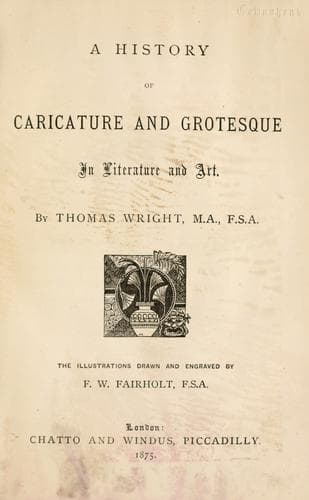
A History of Caricature and Grotesque in Literature and ArtWright, Thomas
History
A History of Caricature and Grotesque in Literature and Art
Wright, Thomas
Caricature -- History
Marguerite was herself a poetess, and she loved above all things
those gay, and seldom very delicate, stories, the telling of which
was at that time one of the favourite amusements of the evening,
and one in which she was known to excel. Her poetical writings were
collected and printed, under her own authority, in 1547, by her then
_valet-de-chambre_, Jean de la Haye, who dedicated the volume to her
daughter. They are all graceful, and some of them worthy of the best
poets of her time. The title of this collection was, punning upon
her name, which means a pearl, "Marguerites de la Marguerite des
princesses, très illustre reyne de Navarre." Marguerite's stories
(_nouvelles_) were more celebrated than her verses, and are said to
have been committed to writing under her own dictation. All the ladies
of her court possessed copies of them in writing. It is understood to
have been her intention to form them into ten days' tales, of ten in
each day, so as to resemble the "Decameron" of Boccaccio, but only
eight days were finished at the time of her death, and the imperfect
work was published posthumously by her _valet-de-chambre_, Claude
Gruget, under the title of "L'Heptameron, ou Histoire des Amants
Fortunés." It is by far the best collection of stories of the sixteenth
century. They are told charmingly, in language which is a perfect model
of French composition of that age, but they are all tales of gallantry
such as could only be repeated in polite society in an age which was
essentially licentious. Queen Marguerite died on the 21st of December,
1549, and was buried in the cathedral of Pau. Her death was a subject
of regret to all that was good and all that was poetic, not only in
France, but in Europe, which had been accustomed to look upon her as
the tenth Muse and the fourth Grace:--
_Musarum decima et Charitum quarta, inclyta regum
Et soror et conjux, Marguaris illa jacet._
Public-domain text, read in full here on John Shaqi.
Reviews
Reviews
No reviews yet
Be the first to share your thoughts on this work.
Elsewhere in the archive
Join the Discussion
Join the discussion
Sign in to leave a comment or review.
Sign InorCreate an account