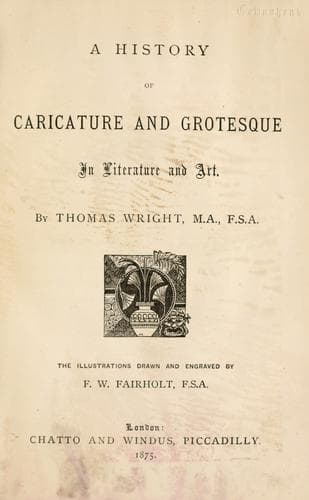
A History of Caricature and Grotesque in Literature and ArtWright, Thomas
History
A History of Caricature and Grotesque in Literature and Art
Wright, Thomas
Caricature -- History
In England, as in Athens of old, perfect comedy arose gradually out
of the personalities of the rude dramatic attempts of an earlier
period. Such productions as Ralph Roister Doister and Gammer Gurton's
Needle were mere imperfect attempts at, we may perhaps rather say
feelers towards, comedy itself--that drama, the object of which was to
caricature, and thus to dissect and apply correctives to, the vices
and weaknesses of contemporary society. The genius of Shakespeare was
far too exquisitely poetical to qualify him for a task like this; it
wanted some one who could use the lancet and scalpel skilfully, but
soberly, and who was not liable to be led astray by too much vigour of
imagination.
Such a one was Ben Jonson, whom we may rightly consider as the father
of English comedy. "Bartholomew Fair," first performed at the Hope
Theatre, on Bankside, London, on the 31st of October, 1614, is the
most perfect and most remarkable example of the truly English comedy,
remarkable, among many other things, for the extraordinary number of
characters who were brought upon the stage in one piece, and who are
all at the same time grouped and individualised with a skill that
reminds us of the pictorial triumphs of a Callot or a Hogarth. London
life is placed before us in all its more popular forms in one grand
tableau, the one in which it would show itself in its more grotesque
attitudes; the London citizen, his vain or easy wife, sharpers of
every description, and their victims no less varied in character,
the petty city officers, all come in for their share of satire. The
different groups are distributed so naturally, that it is difficult
to say who is the principal character of the piece--and who ever was
the principal character in Bartholomew Fair? Perhaps the character of
Cokes, the young booby squire from Harrow--for in those times even
so near London as Harrow, a young squire was considered to be in all
probability but a young country booby--strikes us most. It is said to
have been at a later period the favourite character of Charles II.
Among the other principal characters of the play are a proctor of
the Arches Court named Littlewit, who imagines himself to be a _bel
esprit_ of the first order; his wife, and her mother, dame Purecraft,
who is a widow; Justice Overdo, a London magistrate, to whose ward,
Grace Wellborn, Cokes is affianced in marriage; a zealous Puritan,
named Zeal-of-the-land Busy, who is a suitor to the widow Purecraft,
herself also a Puritan; Winwife, Busy's rival; and a gamester named
Tom Quarlous, who figures as Winwife's friend and companion. All these
meet in town, on the morning of the fair, Cokes under the care of a
sort of steward or upper servant, named Waspe, who was of a quarrelsome
disposition, and separate in groups among the crowd which filled
Smithfield and its vicinity, each having their separate adventures, but
meeting from time to time, and reassembling at the end. Cokes behaves
Public-domain text, read in full here on John Shaqi.
Reviews
Reviews
No reviews yet
Be the first to share your thoughts on this work.
Elsewhere in the archive
Join the Discussion
Join the discussion
Sign in to leave a comment or review.
Sign InorCreate an account