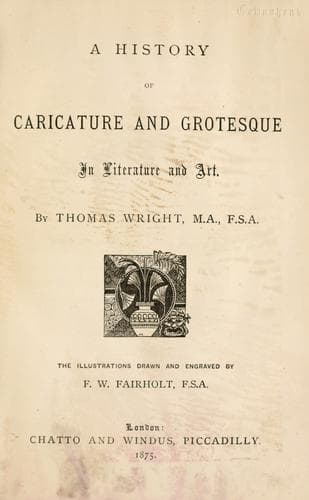
A History of Caricature and Grotesque in Literature and ArtWright, Thomas
History
A History of Caricature and Grotesque in Literature and Art
Wright, Thomas
Caricature -- History
_Thun_.--For the Thunder will do't.
_Light_.--For the Lightning will shoot.
_Thun_.--I'll give you dash for dash.
_Light_.--I'll give you flash for flash.
Gallants, I'll singe your feather.
_Thun_.--I'll Thunder you together.
_Both_.--Look to't, look to't; we'll do't, we'll do't;
look to't; we'll do't. [_Twice or thrice repeated._
Bayes calls this "but a slash of a prologue," in reply to which, Smith
observes, "Yes; 'tis short, indeed, but very terrible." It is a parody
on a scene in "The Slighted Maid," a play by Sir Robert Stapleton,
where Thunder and Lightning were introduced, and their conversation
begins in the same words. But the poet has another difficulty on which
he desires the opinion of his visitors. "I have made," he says, "one of
the most delicate, dainty similes in the whole world, 'egad, if I knew
how to apply it. 'Tis," he adds, "an allusion to love." This is the
simile--
_So boar and sow, when any storm is nigh
Snuff up, and smell it gathering in the sky;
Boar beckons sow to trot in chesnut groves,
And there consummate their unfinished loves:
Pensive in mud they wallow all alone,
And snore and gruntle to each others moan._
It is a rather coarse, but clever parody on a simile in Dryden's
"Conquest of Granada," part ii.:--
_So two kind turtles, when a storm is nigh,
Look up, and see it gathering in the sky;
Each calls his mate to shelter in the groves,
Leaving, in murmurs, their unfinished loves;
Perch'd on some dropping branch, they sit alone,
And coo, and hearken to each other's moan._
It is decided that the simile should be added to the prologue, for, as
Johnson remarks to Bayes, "Faith, 'tis extraordinary fine, and very
applicable to Thunder and Lightning, methinks, because it speaks of a
storm." In the second act we come to the opening of the play, the first
scene consisting of whispering, in ridicule of a scene in Davenant's
"Play-house to Let," where Drake senior says--
_Draw up your men,
And in low whispers give your orders out._
In fact, the Gentleman-Usher and the Physician of the two kings of
Brentford appear upon the scene alone, and discuss a plot to dethrone
the two kings of Brentford, which they communicate by whispers into
each other's ears, which are totally inaudible. In Scene ii., "Enter
the two kings, hand in hand," and Bayes remarks to his visitors,
"Oh! these are now the two kings of Brentford; take notice of their
style--'twas never yet upon the stage; but, if you like it, I could
make a shift, perhaps, to show you a whole play, writ all just so." The
kings begin, rather familiarly, because, as Bayes adds, "they are both
persons of the same quality:"--
_1st King._--Did you observe their whispers, brother king?
Public-domain text, read in full here on John Shaqi.
Reviews
Reviews
No reviews yet
Be the first to share your thoughts on this work.
Elsewhere in the archive
Join the Discussion
Join the discussion
Sign in to leave a comment or review.
Sign InorCreate an account