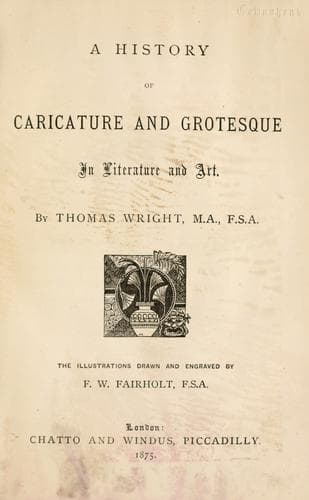
A History of Caricature and Grotesque in Literature and ArtWright, Thomas
History
A History of Caricature and Grotesque in Literature and Art
Wright, Thomas
Caricature -- History
_Lieut.-Gen._--You'll find my Mortlake boys will do them right,
Unless by Fulham numbers over-laid.
_Gen._--Let the left wing of Twick'n'am foot advance,
And line that eastern hedge.
_Lieut.-Gen._--The horse I raised in Petty France
Shall try their chance,
And scour the meadows, overgrown with sedge.
_Gen._--Stand: give the word.
_Lieut.-Gen._--Bright sword.
_Gen._--That may be thine,
But 'tis not mine.
_Lieut.-Gen._--Give fire, give fire, at once give fire,
And let those recreant troops perceive mine ire.
_Gen._--Pursue, pursue; they fly,
That first did give the lie! [_Exeunt._
Thus the battle is carried on in talk between two individuals. Bayes
alleges, as an excuse for introducing these trivial names of places,
that "the spectators know all these towns, and may easily conceive
them to be within the dominions of the two kings of Brentford."
The battle is finally stopped by an eclipse, and three personages,
representing the sun, moon, and earth, advance upon the stage, and
by dint of singing and manœuvring, one gets in a line between the
other two, and this, according to the strict rules of astronomy,
constituted the eclipse. The eclipse is followed by another battle
of a more desperate character, to which a stop is put in an equally
extraordinary manner, by the entrance of the furious hero Drawcansir,
who slays all the combatants on both sides. The marriage of prince
Prettyman was to form the subject of the fifth act, but while Bayes,
Johnson, and Smith withdraw temporarily, all the players, in disgust,
run away to their dinners, and thus ends "The Rehearsal" of Mr. Bayes's
play. The epilogue returns to the moral which the play was designed to
inculcate:--
_The play is at an end, but where's the plot?
That circumstance the poet Bayes forgot.
And we can boast, though 'tis a plotting age,
No place is freer from it than the stage._
Formerly people sought to write so that they might be understood, but
"this new way of wit" was altogether incomprehensible:--
_Wherefore, for ours, and for the kingdom's peace,
May this prodigious way of writing cease;
Let's have, at least once in our lives, a time
When we may hear some reason, not all rhyme.
We have this ten years felt its influence;
Pray let this prove a year of prose and sense._
Public-domain text, read in full here on John Shaqi.
Reviews
Reviews
No reviews yet
Be the first to share your thoughts on this work.
Elsewhere in the archive
Join the Discussion
Join the discussion
Sign in to leave a comment or review.
Sign InorCreate an account