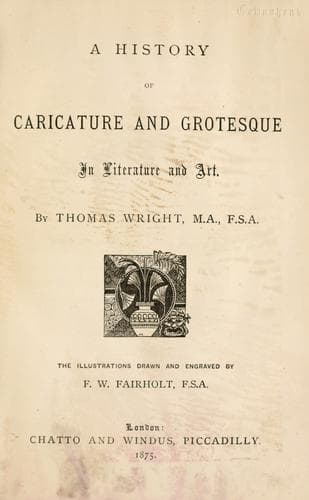
A History of Caricature and Grotesque in Literature and ArtWright, Thomas
History
A History of Caricature and Grotesque in Literature and Art
Wright, Thomas
Caricature -- History
English comedy was certainly greatly reformed, in some senses of the
word reform, during the period which followed the publication of "The
Rehearsal," and, in the hands of writers like Wycherley, Shadwell,
Congreve, and D'Urfey, the dulness of the Howards was exchanged for
an extreme degree of vivacity. The plot was as little considered as
ever--it was a mere peg on which to hang scenes brilliant with wit
and _repartee_. The small intrigue is often but a frame for a great
picture of society in its forms then most open to caricature, with
all the petty intrigues inseparable from it. "Epsom Wells," one of
Shadwell's earlier comedies, and perhaps his best, will bear comparison
with Jonson's "Bartholomew Fair." The personages represented in it
are exactly those which then shone in such society--three "men of wit
and pleasure," one of the class of country squires whom the wits of
London loved to laugh at, and who is described as "a country justice,
a public spirited, politick, discontented fop, an immoderate hater of
London, and a lover of the country above measure, a hearty true English
coxcomb." Then we have "two cheating, sharking, cowardly bullies."
The citizens of London are represented by Bisket, "a comfit-maker, a
quiet, humble, civil cuckold, governed by his wife, whom he very much
fears and loves at the same time, and is very proud of," and Fribble,
"a haberdasher, a surly cuckold, very conceited, and proud of his
wife, but pretends to govern and keep her under," and their wives, the
first "an impertinent, imperious strumpet," and the other, "an humble,
submitting wife, who jilts her husband that way, a very ----." One
or two other characters of the same stamp, with "two young ladies of
wit, beauty, and fortune," who behave themselves not much better than
the others, and a full allowance of "parsons, hectors, constables,
watchmen, and fiddlers," complete the _dramatis personæ_ of "Epsom
Wells." With such materials anybody will understand the character of
the piece, which was brought out on the stage in 1672. "The Squire of
Alsatia," by the same author, brought upon the stage in the eventful
year 1688, is a vivid picture of one of the wildest phases of London
life in those still rather primitive times. Alsatia, as every reader of
Walter Scott knows, was a cant name for the White Friars, in London, a
locality which, at that time, was beyond the reach of the law and its
officers, a refuge for thieves and rogues, and especially for debtors,
where they could either resist with no great fear of being overcome,
or, when resistance was no longer possible, escape with ease. With such
a scene, and such people for characters, we are not surprised that the
printed edition of this play is prefaced by a vocabulary of the cant
words employed in it. The principal characters in the play are of the
same class with those which form the staple of all these old comedies.
First there is a country father or uncle, who is rich and severe upon
Public-domain text, read in full here on John Shaqi.
Reviews
Reviews
No reviews yet
Be the first to share your thoughts on this work.
Elsewhere in the archive
Join the Discussion
Join the discussion
Sign in to leave a comment or review.
Sign InorCreate an account