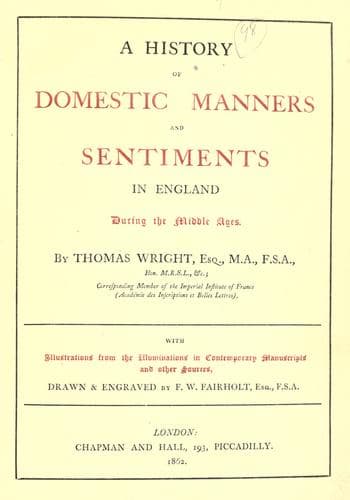
A History of Domestic Manners and Sentiments in England During the Middle Ages — John Shaqi
A History of Domestic Manners and Sentiments in England During the Middle AgesWright, Thomas
History
A History of Domestic Manners and Sentiments in England During the Middle Ages
Wright, Thomas
England -- Social life and customs -- 1066-1485
Having given these few examples of the general forms of the implements
in use among the Saxons before their conversion to Christianity, as
much to illustrate their manners as described by Beowulf, as to show
what classes of types were originally Saxon, we will proceed to treat
of their domestic manners as we learn them from the more numerous and
more definite documents of a later period. We shall find it convenient
to consider the subject separately as it regards in-door life and
out-door life, and it will be proper first that we should form some
definite notion of an Anglo-Saxon house.
[Illustration: _No. 11. Germano-Saxon Knife._]
We can already form some notion of the primeval Saxon mansion from
our brief review of the poem of Beowulf; and we shall find that it
continued nearly the same down to a late period. The most important
part of the building was the hall, on which was bestowed all the
ornamentation of which the builders and decorators of that early period
were capable. Halls built of stone are alluded to in a religious poem
at the beginning of the Exeter book; yet, in the earlier period at
least, there can be little doubt that the materials of building were
chiefly wood. Around, or near this hall, stood, in separate buildings,
the bed-chambers, or bowers (_búr_), of which the latter name is only
now preserved as applied to a summer-house in a garden; but the reader
of old English poetry will remember well the common phrase of a _bird
in bure_, a lady in her bower or chamber. These buildings, and the
household offices, were all grouped within an inclosure, or outward
wall, which, I imagine, was generally of earth, for the Anglo-Saxon
word, _weall_, was applied to an earthen rampart, as well as to
masonry. What is termed in the poem of Judith, _wealles geát_, the gate
of the wall, was the entrance through this inclosure or rampart. I am
convinced that many of the earth-works, which are often looked upon as
ancient camps, are nothing more than the remains of the inclosures of
Anglo-Saxon residences.
In Beowulf, the sleeping-rooms of Hrothgar and his court seem to have
been so completely detached from the hall, that their inmates did not
hear the combat that was going on in the latter building at night. In
smaller houses the sleeping-rooms were fewer, or none, until we arrive
at the simple room in which the inmates had board and lodging together,
with a mere hedge for its inclosure, the prototype of our ordinary
cottage and garden. The wall served for a defence against robbers and
enemies, while, in times of peace and tranquillity, it was a protection
from indiscreet intruders, for the doors of the hall and chambers seem
to have been generally left open. Beggars assembled round the door of
the wall--the _ostium domûs_--to wait for alms.
Public-domain text, read in full here on John Shaqi.
Reviews
Reviews
No reviews yet
Be the first to share your thoughts on this work.
Join the Discussion
Join the discussion
Sign in to leave a comment or review.
Sign InorCreate an account