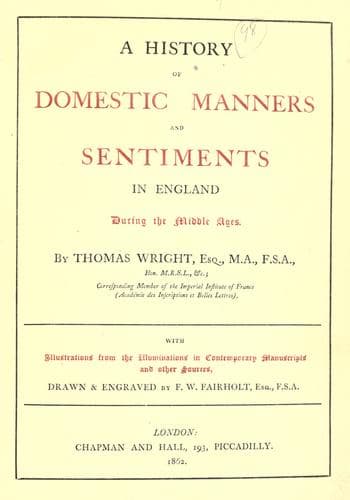
A History of Domestic Manners and Sentiments in England During the Middle AgesWright, Thomas
History
A History of Domestic Manners and Sentiments in England During the Middle Ages
Wright, Thomas
England -- Social life and customs -- 1066-1485
We have unfortunately no special descriptions of Anglo-Saxon houses,
but scattered incidents in the Anglo-Saxon historians show us that
this general arrangement of the house lasted down to the latest
period of their monarchy. Thus, in the year 755, Cynewulf, king of
the West Saxons, was murdered at Merton by the atheling Cyneard. The
circumstances of the story are but imperfectly understood, unless we
bear in mind the above description of a house. Cynewulf had gone to
Merton privately, to visit a lady there, who seems to have been his
mistress, and he only took a small party of his followers with him.
Cyneard, having received information of this visit, assembled a body
of men, entered the inclosure of the house unperceived (as appears by
the context), and surrounded the detached chamber (_búr_) in which was
the king with the lady. The king, taken by surprise, rushed to the
door (_on tha duru eode_), and was there slain fighting. The king’s
attendants, although certainly within the inclosure of the house, were
out of hearing of this sudden fray (they were probably in the hall),
but they were roused by the woman’s screams, rushed to the spot, and
fought till, overwhelmed by the numbers of their enemies, they also
were all slain. The murderers now took possession of the house, and
shut the entrance gate of the wall of inclosure, to protect themselves
against the body of the king’s followers who had been left at a
distance. These, next day, when they heard what had happened, hastened
to the spot, attacked the house, and continued fighting around the gate
(_ymb thá gatu_) until they made their way in, and slew all the men
who were there. Again, we are told, in the Ramsey Chronicle published
by Gale, of a rich man in the Danish period, who was oppressive to
his people, and, therefore, suspicious of them. He accordingly had
four watchmen every night, chosen alternately from his household,
who kept guard at the outside of his hall, evidently for the purpose
of preventing his enemies from being admitted into the inclosure by
treachery. He lay in his chamber, or bower. One night, the watchmen
having drunk more than usual, were unguarded in their speech, and
talked together of a plot into which they had entered against the life
of their lord. He, happening to be awake, heard their conversation from
his chamber, and defeated their project. We see here the chamber of the
lord of the mansion so little substantial in its construction that its
inmates could hear what was going on out of doors. At a still later
period, a Northumbrian noble, whom Hereward visited in his youth, had a
building for wild beasts within his house or inclosure. One day a bear
broke loose, and immediately made for the chamber or bower of the lady
of the household, in which she had taken shelter with her women, and
whither, no doubt, the savage animal was attracted by their cries. We
gather from the context that this asylum would not have availed them,
Public-domain text, read in full here on John Shaqi.
Reviews
Reviews
No reviews yet
Be the first to share your thoughts on this work.
Join the Discussion
Join the discussion
Sign in to leave a comment or review.
Sign InorCreate an account