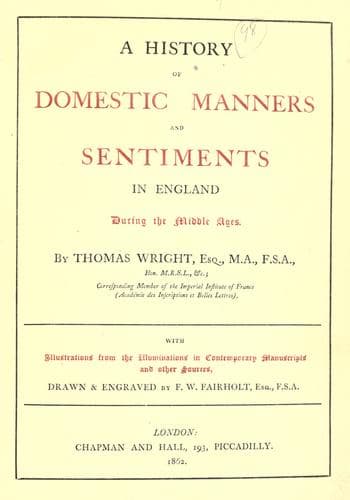
A History of Domestic Manners and Sentiments in England During the Middle AgesWright, Thomas
History
A History of Domestic Manners and Sentiments in England During the Middle Ages
Wright, Thomas
England -- Social life and customs -- 1066-1485
A trouvère of the thirteenth century, named Robert de Blois, compiled a
code of instructions in good manners for young ladies in French verse,
under the title of the “Chastisement des Dames,” which is printed by
Barbazan, and forms a curious illustration of feudal domestic manners.
It was unbecoming in a lady, according to Robert de Blois, to talk too
much; she ought especially to refrain from boasting of the attentions
paid to her by the other sex; and she was recommended not to show
too much freedom in her games and amusements, lest the men should be
encouraged to libertinism. In going to church, she was not to “trot
or run,” but to walk seriously, not going in advance of her company,
and looking straight before her, and not to this side or the other,
but to salute “debonairely” all persons she met. She is recommended
not to let men put their hands into her breasts, or kiss her on the
mouth, as it might lead to greater familiarities. She was not to look
at a man too much, unless he were her acknowledged lover; and when
she had a lover, she was not to boast or talk too much of him. She
was not to expose her body uncovered out of vanity, as her breast, or
her legs, or her sides, nor to undress in the presence of men. She
was not to be too ready in accepting presents from the other sex.
The ladies are particularly warned against scolding and disputing,
against swearing, against eating and drinking too freely at table, and
against getting drunk, the latter being a practice from which much
mischief might arise. A lady was not to cover her face when the went
in public, as a handsome face was made to be seen, and it was not good
manners to remain with the face covered before a gentleman of rank.
An exception, however, is made in the case of ugly or deformed faces,
which might be covered. There was another exception to the counsel
just mentioned. “A lady who is pale-faced, or who has not a good
smell, ought to breakfast early in the morning; for good wine gives a
very good colour; and she who eats and drinks well must heighten her
colour.” One who has bad breath is recommended to eat aniseed, fennel,
and cumin to her breakfast, and to avoid breathing in people’s faces.
A lady is to be very attentive to her behaviour in church, rules for
which are given. If she could sing, she was to do so when asked, and
not require too much pressing. Ladies are further recommended to keep
their hands clean, to cut their nails often, and not to suffer them to
grow beyond the finger, or to harbour dirt. In passing other people’s
houses, ladies were not to look into them; “for a person often does
things privately in his house, which he would not wish to be seen, if
any one should come before his door.” For this reason, too, when a lady
went into another person’s house, she is recommended to cough at the
entrance, or to speak out loud, so that the inmates might not be taken
by surprise. The directions for a lady’s behaviour at table are very
particular.
Public-domain text, read in full here on John Shaqi.
Reviews
Reviews
No reviews yet
Be the first to share your thoughts on this work.
Elsewhere in the archive
Join the Discussion
Join the discussion
Sign in to leave a comment or review.
Sign InorCreate an account