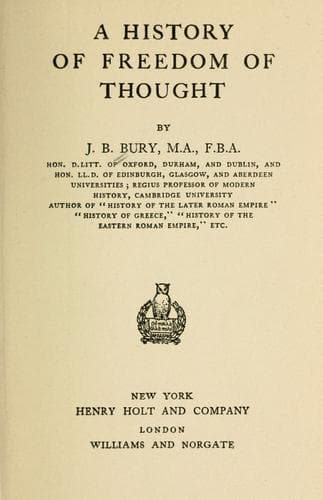
A History of Freedom of ThoughtBury, J. B. (John Bagnell)
Religion
A History of Freedom of Thought
Bury, J. B. (John Bagnell)
Free thought -- History; Rationalism -- History
Note: Numbers enclosed in square brackets are page numbers.
HOME UNIVERSITY LIBRARY
OF MODERN KNOWLEDGE
No. 69
Editors:
HERBERT FISHER, M.A., F.B.A.
Prof. GILBERT MURRAY, Litt.D., LL.D., F.B.A.
Prof. J. ARTHUR THOMSON, M.A.
Prof. WILLIAM T. BREWSTER, M.A.
A HISTORY OF FREEDOM OF THOUGHT
BY
J. B. BURY, M.A., F.B.A
HON. D.LITT. OF OXFORD, DURHAM, AND DUBLIN, AND HON. LL.D. OF EDINBURGH,
GLASGOW, AND ABERDEEN UNIVERSITIES; REGIUS PROFESSOR OF MODERN HISTORY,
CAMBRIDGE UNIVERSITY
AUTHOR OF “HISTORY OF THE LATTER ROMAN EMPIRE,” “HISTORY OF GREECE,”
“HISTORY OF THE EASTERN ROMAN EMPIRE,” ETC.
[IV]
1913,
[V]
CONTENTS
CHAP.
I Introductory
II Reason Free (Greece And Rome)
III Reason in Prison (The Middle Ages)
IV Prospect of Deliverance (The Renaissance and the Reformation)
V Religious Toleration
VI The Growth of Rationalism (Seventeenth and Eighteenth Centuries)
VII The Progress of Rationalism (Nineteenth Century)
VIII The Justification of Liberty of Thought
Bibliography
Index
[7] A HISTORY OF FREEDOM OF THOUGHT
CHAPTER I
FREEDOM OF THOUGHT AND THE FORCES AGAINST IT
(INTRODUCTORY)
IT is a common saying that thought is free. A man can never be hindered
from thinking whatever he chooses so long as he conceals what he thinks.
The working of his mind is limited only by the bounds of his experience
and the power of his imagination. But this natural liberty of private
thinking is of little value. It is unsatisfactory and even painful to
the thinker himself, if he is not permitted to communicate his thoughts
to others, and it is obviously of no value to his neighbours. Moreover
it is extremely difficult to hide thoughts that have any power over the
mind. If a man’s thinking leads him to call in question ideas and
customs which regulate the behaviour of those about him, to reject
beliefs which they hold, to see better ways of life than those they
follow, it is almost
[8] impossible for him, if he is convinced of the truth of his own
reasoning, not to betray by silence, chance words, or general attitude
that he is different from them and does not share their opinions. Some
have preferred, like Socrates, some would prefer to-day, to face death
rather than conceal their thoughts. Thus freedom of thought, in any
valuable sense, includes freedom of speech.
At present, in the most civilized countries, freedom of speech is taken
as a matter of course and seems a perfectly simple thing. We are so
accustomed to it that we look on it as a natural right. But this right
has been acquired only in quite recent times, and the way to its
attainment has lain through lakes of blood. It has taken centuries to
persuade the most enlightened peoples that liberty to publish one’s
opinions and to discuss all questions is a good and not a bad thing.
Human societies (there are some brilliant exceptions) have been
generally opposed to freedom of thought, or, in other words, to new
ideas, and it is easy to see why.
Public-domain text, read in full here on John Shaqi.
Reviews
Reviews
No reviews yet
Be the first to share your thoughts on this work.
Join the Discussion
Join the discussion
Sign in to leave a comment or review.
Sign InorCreate an account