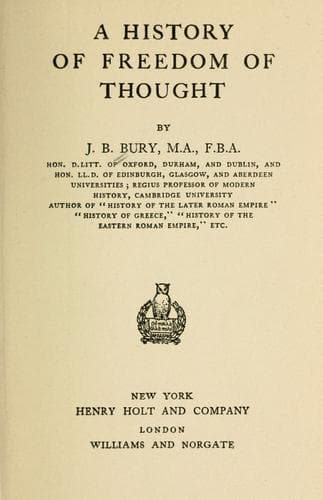
A History of Freedom of ThoughtBury, J. B. (John Bagnell)
Religion
A History of Freedom of Thought
Bury, J. B. (John Bagnell)
Free thought -- History; Rationalism -- History
[54] persecution. The truth is that Sacred Books are an obstacle to
moral and intellectual progress, because they consecrate the ideas of a
given epoch, and its customs, as divinely appointed. Christianity, by
adopting books of a long past age, placed in the path of human
development a particularly nasty stumbling-block. It may occur to one to
wonder how history might have been altered —altered it surely would have
been—if the Christians had cut Jehovah out of their programme and,
content with the New Testament, had rejected the inspiration of the Old.
Under Constantine the Great and his successors, edict after edict
fulminated against the worship of the old pagan gods and against
heretical Christian sects. Julian the Apostate, who in his brief reign
(A.D. 361–3) sought to revive the old order of things, proclaimed
universal toleration, but he placed Christians at a disadvantage by
forbidding them to teach in schools. This was only a momentary check.
Paganism was finally shattered by the severe laws of Theodosius I (end
of fourth century). It lingered on here and there for more than another
century, especially at Rome and Athens, but had little importance. The
Christians were more concerned in striving among themselves than in
[55] crushing the prostrate spirit of antiquity. The execution of the
heretic Priscillian in Spain (fourth century) inaugurated the punishment
of heresy by death. It is interesting to see a non-Christian of this age
teaching the Christian sects that they should suffer one another.
Themistius in an address to the Emperor Valens urged him to repeal his
edicts against the Christians with whom he did not agree, and expounded
a theory of toleration. “The religious beliefs of individuals are a
field in which the authority of a government cannot be effective;
compliance can only lead to hypocritical professions. Every faith should
be allowed; the civil government should govern orthodox and heterodox to
the common good. God himself plainly shows that he wishes various forms
of worship; there are many roads by which one can reach him.”
No father of the Church has been more esteemed or enjoyed higher
authority than St. Augustine (died A.D. 410). He formulated the
principle of persecution for the guidance of future generations, basing
it on the firm foundation of Scripture—on words used by Jesus Christ in
one of his parables, “Compel them to come in.” Till the end of the
twelfth century the Church worked hard to suppress heterodoxies. There
was much
Public-domain text, read in full here on John Shaqi.
Reviews
Reviews
No reviews yet
Be the first to share your thoughts on this work.
Join the Discussion
Join the discussion
Sign in to leave a comment or review.
Sign InorCreate an account