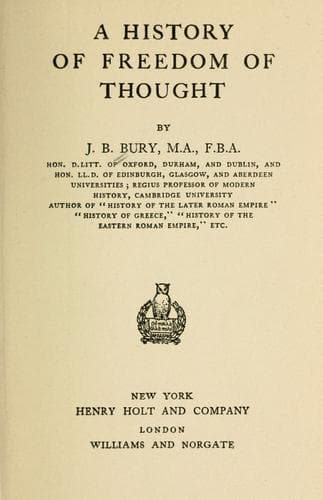
A History of Freedom of ThoughtBury, J. B. (John Bagnell)
Religion
A History of Freedom of Thought
Bury, J. B. (John Bagnell)
Free thought -- History; Rationalism -- History
[56] persecution, but it was not systematic. There is reason to think
that in the pursuit of heresy the Church was mainly guided by
considerations of its temporal interest, and was roused to severe action
only when the spread of false doctrine threatened to reduce its revenues
or seemed a menace to society. At the end of the twelfth century
Innocent III became Pope and under him the Church of Western Europe
reached the height of its power. He and his immediate successors are
responsible for imagining and beginning an organized movement to sweep
heretics out of Christendom. Languedoc in Southwestern France was
largely populated by heretics, whose opinions were considered
particularly offensive, known as the Albigeois. They were the subjects
of the Count of Toulouse, and were an industrious and respectable
people. But the Church got far too little money out of this anti-
clerical population, and Innocent called upon the Count to extirpate
heresy from his dominion. As he would not obey, the Pope announced a
Crusade against the Albigeois, and offered to all who would bear a hand
the usual rewards granted to Crusaders, including absolution from all
their sins. A series of sanguinary wars followed in which the
Englishman, Simon de Montfort, took part. There were
[57] wholesale burnings and hangings of men, women and children. The
resistance of the people was broken down, though the heresy was not
eradicated, and the struggle ended in 1229 with the complete humiliation
of the Count of Toulouse. The important point of the episode is this:
the Church introduced into the public law of Europe the new principle
that a sovran held his crown on the condition that he should extirpate
heresy. If he hesitated to persecute at the command of the Pope, he must
be coerced; his lands were forfeited; and his dominions were thrown open
to be seized by any one whom the Church could induce to attack him. The
Popes thus established a theocratic system in which all other interests
were to be subordinated to the grand duty of maintaining the purity of
the Faith.
But in order to root out heresy it was necessary to discover it in its
most secret retreats. The Albigeois had been crushed, but the poison of
their doctrine was not yet destroyed. The organized system of searching
out heretics known as the Inquisition was founded by Pope Gregory IX
about A.D. 1233, and fully established by a Bull of Innocent IV (A.D.
1252) which regulated the machinery of persecution “as an integral part
of the social edifice in every city and every
[58] State.” This powerful engine for the suppression of the freedom of
men’s religious opinions is unique in history.
Public-domain text, read in full here on John Shaqi.
Reviews
Reviews
No reviews yet
Be the first to share your thoughts on this work.
Join the Discussion
Join the discussion
Sign in to leave a comment or review.
Sign InorCreate an account