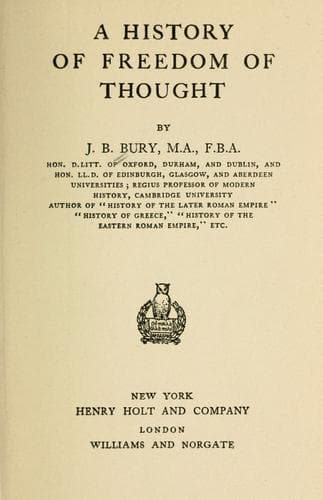
A History of Freedom of ThoughtBury, J. B. (John Bagnell)
Religion
A History of Freedom of Thought
Bury, J. B. (John Bagnell)
Free thought -- History; Rationalism -- History
But if Voltaire’s system of toleration is limited, it is wide compared
with the religious establishment advocated by his contemporary,
Rousseau. Though of Swiss birth, Rousseau belongs to the literature and
history of France; but it was not for nothing that he was brought up in
the traditions of Calvinistic Geneva. His ideal State would, in its way,
have been little better than any theocracy. He proposed to establish a
“civil religion” which was to be a sort of undogmatic Christianity. But
certain dogmas, which he considered essential, were to be imposed on all
citizens on pain of banishment. Such were the existence of a deity, the
future bliss of the good and punishment of the bad, the duty of
tolerance towards all those who accepted the fundamental
[111] articles of faith. It may be said that a State founded on this
basis would be fairly inclusive—that all Christian sects and many deists
could find a place in it. But by imposing indispensable beliefs, it
denies the principle of toleration. The importance of Rousseau’s idea
lies in the fact that it inspired one of the experiments in religious
policy which were made during the French Revolution.
The Revolution established religious liberty in France. Most of the
leaders were unorthodox. Their rationalism was naturally of the
eighteenth-century type, and in the preamble to the Declaration of
Rights (1789) deism was asserted by the words “in the presence and under
the auspices of the Supreme Being” (against which only one voice
protested). The Declaration laid down that no one was to be vexed on
account of his religious opinions provided he did not thereby trouble
public order. Catholicism was retained as the “dominant” religion;
Protestants (but not Jews) were admitted to public office. Mirabeau, the
greatest statesman of the day, protested strongly against the use of
words like “tolerance” and “dominant.” He said: “The most unlimited
liberty of religion is in my eyes a right so sacred that to express it
by the word ‘toleration’ seems to me itself a sort of tyranny,
[112] since the authority which tolerates might also not tolerate.” The
same protest was made in Thomas Paine’s Rights of Man which appeared two
years later: “Toleration is not the opposite of Intolerance, but is the
counterfeit of it. Both are despotisms. The one assumes itself the right
of withholding liberty of conscience, and the other of granting it.”
Paine was an ardent deist, and he added: “Were a bill brought into any
parliament, entitled ‘An Act to tolerate or grant liberty to the
Almighty to receive the worship of a Jew or a Turk,’ or ‘to prohibit the
Almighty from receiving it,’ all men would startle and call it
blasphemy. There would be an uproar. The presumption of toleration in
religious matters would then present itself unmasked.”
Public-domain text, read in full here on John Shaqi.
Reviews
Reviews
No reviews yet
Be the first to share your thoughts on this work.
Elsewhere in the archive
Join the Discussion
Join the discussion
Sign in to leave a comment or review.
Sign InorCreate an account