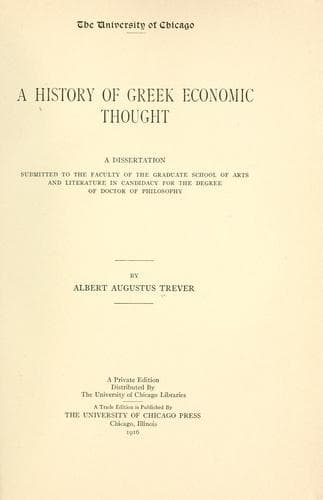
A History of Greek Economic ThoughtTrever, Albert Augustus
History
A History of Greek Economic Thought
Trever, Albert Augustus
Economics -- Greece -- History; Thesis (Ph. D.)
1131_b_27-32: ἡ διανομὴ ἔσται κατὰ τὸν λόγον τὸν αὐτὸν ὅνπερ ἔχουσι
πρὸς ἄλληλα τὰ εἰσενεχθέντα. Cf. _Mag. mor._ i. 33. 1193_b_36 ff.
Stewart (_op. cit._, I, 432) says that the expression ἡ τῶν κοινῶν
διανομή must mean more than distribution by some central authority,
for the most important form of it is the distribution of wealth,
operating under economic laws that regulate wages and profits.
Footnote 781:
1131_a_24-26.
Footnote 782:
_Ibid._ 22-24. For Plato, cf. pp. 55 f.
Footnote 783:
_Ibid._ 26-29.
Footnote 784:
_Ibid._; _Pol._ iii. 1280_a_7 ff.; 1282_b_23 ff.
Footnote 785:
Cf. above, pp. 113, and 93 ff. on labor.
Footnote 786:
_Pol._ ii. 4. 1262_b_2 f.
Footnote 787:
1264_a_11-17; 36-38; 1264_b_11-13, all discussed above under Plato.
Footnote 788:
iv (vii). 1329_b_41 ff.
Footnote 789:
1271_a_29-37; 1272_a_12-21.
Footnote 790:
_N. Eth._ v. chaps. 4-5, discussed above.
Footnote 791:
_Pol._ vi (iv). 1295_b_35 ff.
Footnote 792:
v (vi). 1320_a_33 ff.; cf. pp. 95 f.; cf. especially 35: τεχναστέον
οὖν ὅπως, ἂν εὐπορία γένοιτο χρόνιος, and 1267_b_3 ff. on the
insatiety of the masses. He believed that the state doles for mere
consumption aggravated the evil—a very sane doctrine which our city
charity organizations are prone to overlook.
Footnote 793:
Cf. Poehlmann, _op. cit._, II, 339 f., on this passage.
Footnote 794:
Cf. above, n. 4 above, and pp. 95 f.
Footnote 795:
1320_a_36: ἐπεὶ δὲ συμφέρει τοῦτο καὶ τοῖς εὐπόροις, and 34, τοῦτο γὰρ
αἴτιον τοῦ μοχθηρὰν εἶναι τὴν δημοκρατίαν; viz., undue poverty of the
masses.
Footnote 796:
_Op. cit._, p. 7; cf. Poehlmann, _op. cit._, I, 600, on this point.
Footnote 797:
_Pol._ ii. 7. 1266_b_14-25, as advocated by Phaleas; cf. above. Cf.
_infra_ for Aristotle’s advocacy of equality in landed property.
Footnote 798:
1267_a_37-39.
Footnote 799:
_Ibid._ 39-41.
Footnote 800:
1267_b_1-4; vii (vi). 1320_a_31; cf. p. 117 on this idea. He does not
consider the rise in the cost of living.
Footnote 801:
1266_b_28-30.
Footnote 802:
Cf. Bonar, _op. cit._, p. 45.
Footnote 803:
Aristotle, like Plato, strongly emphasizes education as a great cure
for the ills of the state (1310_a_15 ff.). It should be common to all
citizens, and be publicly supervised (1336_a_22 ff.).
Footnote 804:
1267_a_13-17.
Footnote 805:
1266_b_38-1267_a_2.
Footnote 806:
_Ecclesiazusae._ Poehlmann (_op. cit._, I, 403) argues that such ideas
were widespread in Greece.
Footnote 807:
_Pol._ iii. 9. 1280_a_14-21: σχεδὸν δ᾽ οἱ πλεῖστοι φαῦλοι κριταὶ περὶ
τῶν οἰκείων. Cf. 7-31, his discriminating remarks on equality in
general.
Footnote 808:
vii (vi). 5; iii. 10; cf. Haney _op. cit._, p. 45.
Footnote 809:
Cf. above on fair exchange; also p. 116 and notes.
Footnote 810:
vi (iv). 4. 1292_a_4-38.
Footnote 811:
Public-domain text, read in full here on John Shaqi.
Reviews
Reviews
No reviews yet
Be the first to share your thoughts on this work.
Elsewhere in the archive
Join the Discussion
Join the discussion
Sign in to leave a comment or review.
Sign InorCreate an account