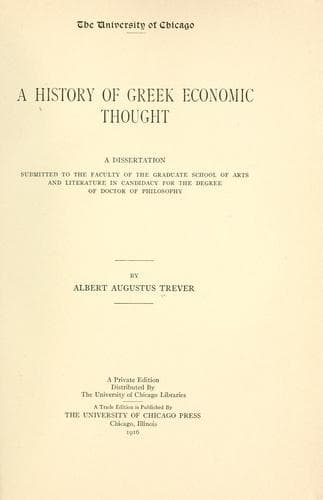
A History of Greek Economic ThoughtTrever, Albert Augustus
History
A History of Greek Economic Thought
Trever, Albert Augustus
Economics -- Greece -- History; Thesis (Ph. D.)
vii (vi). 3. 1318_b_1-5, especially οἱ δὲ κρατοῦντες οὐδὲν
φροντίζουσιν; cf. iii. 9. 1280_a_, especially 22-30, on the false idea
of equality on both sides.
Footnote 812:
i. 1: ζῷον πολιτικόν; 1280_a_31 ff.; 1252_b_30 f.; cf. all of chap. 9
to 1281_a_10.
Footnote 813:
1280_b_10-12, against Lycophron; cf., above, p. 16; καὶ ὁ νόμος
συνθήκη καὶ ... ἐγγυητὴς ἀλλήλοις τῶν δικαίων, ἀλλ᾽ οὐχ οἵος ποιεῖν
ἀγαθοὺς καὶ δικαίους τοὺς πολίτας.
Footnote 814:
_Op. cit._, II, 304.
Footnote 815:
_Pol._ v (viii). 1. 1337_a_27-30, a remarkable passage, suggestive of
Plato and of St. Paul’s analogy of the body. Aristotle paints vividly
the antithesis between political and economic equality, whereby there
grows up a state within a state (1295_b_13 ff.), for he believes with
the author of _Eud. Eth._ vii. 10. 1242_a_, that man is not only a
πολιτικόν, but also an οἰκονομικόν ζῷον. Cl. Poehlmann, _op. cit._, I,
276 ff.
Footnote 816:
1266_b_8-14; 1265_a_38-42; unfair to Plato, as seen above.
Footnote 817:
1266_b_24-28; 1265_a_28-38.
Footnote 818:
1265_b_22 ff.
Footnote 819:
1267_b_9-13.
Footnote 820:
Cf. his criticism of the Spartan system, 1270_a_40 ff.
Footnote 821:
On its wisdom, cf. _infra_; on its feasibility, cf. 1263_b_29: πάμπαν
ἀδύνατος.
Footnote 822:
1261_a_16-1261_b_15.
Footnote 823:
1261_b_30-32; 24-28.
Footnote 824:
32-35.
Footnote 825:
1262_b_4-24.
Footnote 826:
22-24.
Footnote 827:
1262_a_40-1262_b_3.
Footnote 828:
1263_b_30 ff., and preceding note.
Footnote 829:
1263_a_11-16.
Footnote 830:
22-26; 39 f.
Footnote 831:
26-30, citing the proverb κοινὰ τὰ φίλων. Cf. 1329_b_14 ff. _N. Eth._
viii; 8 f. on φιλία; _Pol._ 1252_b_29; 1280_a_25; cf. Xen. _Laced.
Pol._ vi. 3-4.
Footnote 832:
Cf. preceding note, and 1261_b_32 ff.
Footnote 833:
1261_a_30 f. _N. Eth._ v. 5.
Footnote 834:
1263_b_22 f.
Footnote 835:
37-42. But Plato used both methods.
Footnote 836:
1263_b_27-29; e.g., besides the personal satisfaction (1263_a_40 f.),
the opportunity for liberality (1263_b_11-13).
Footnote 837:
iv (vii). 10. 1330_a_5 ff. He would make part of the land public. In
the _Laws_, the expense is met by making the product public.
Footnote 838:
1271_a_29-37.
Footnote 839:
_Ibid._ 28 f.; 1272_a_12-21.
Footnote 840:
Cf. above on socialism in the _Laws_.
Footnote 841:
_Pol._ ii. 1270_a_21 f.; viii (v). 1309_a_23-25, though rather a
measure for an oligarchy; vii (vi). 1319_a_8-13, for a democracy, also
against mortgage on land; cf. Guiraud, _La Prop. fonc._, p. 591. Like
Plato, he opposes free disposal of dowries (1270_a_23-25).
Footnote 842:
Cf. p. 122, n. 1.
Footnote 843:
1330_a_9-23.
Footnote 844:
1265_b_24-26.
Footnote 845:
iv (vii). 1329_a_18-21.
Footnote 846:
1330_a_25-31; 1328_b_40; 1329_a_2; cf. Souchon, _op. cit._, pp. 169
f., on his system as compared with that of the _Laws_.
Footnote 847:
Public-domain text, read in full here on John Shaqi.
Reviews
Reviews
No reviews yet
Be the first to share your thoughts on this work.
Elsewhere in the archive
Join the Discussion
Join the discussion
Sign in to leave a comment or review.
Sign InorCreate an account