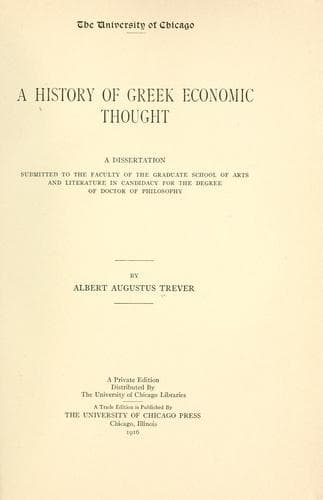
A History of Greek Economic ThoughtTrever, Albert Augustus
History
A History of Greek Economic Thought
Trever, Albert Augustus
Economics -- Greece -- History; Thesis (Ph. D.)
Chrysippus, the greatest of the Stoics,[1017] continued and expanded the
principle that virtue is the only absolute good, and that all other
things are indifferents, depending for their worth upon right use.[1018]
But since the wise alone are capable of right use of externals, they
alone are truly wealthy.[1019] They are wealthy, even though beggars,
and noble though slaves.[1020] They are not eager for wealth[1021] yet
they are good economists, since they know the proper source,[1022] time,
method, and extent of money-making. The worthless, on the other hand,
are most needy, even though wealthy.[1023] Chrysippus seems to have
advanced still farther, in teaching the negative doctrine that wealth is
an evil, since it may come from an evil source,[##] an idea suggestive
of the modern theory of “tainted money.” Naturally, he with the other
Stoics, was in sympathy with the Socratics, in objecting to the use of
one’s knowledge for purposes of money-making.[1024]
The cosmopolitan attitude of the Stoics caused them to be opposed to the
theory of slavery as a natural institution.[1025] They taught that
enforced service is no evidence of slavery,[1026] but that the real
slaves are the ignoble and foolish.[1027] The wise, on the other hand,
alone are free, though they are slaves to countless masters.[1028]
Chrysippus, like Zeno, probably had dreams of a future ideal state,
where the highest eternal law would rule and individual strivings would
be lost in the care for the common weal.[1029] If he taught family
communism, it was doubtless in a Platonic form.[1030]
Utopian social theories after the time of Aristotle were by no means
limited to those of Zeno and Chrysippus. As Souchon has observed,[1031]
the period between the end of the fourth and the beginning of the second
centuries was especially favorable to such speculation. The skeptical
criticism of the Sophists had prepared the following generations to call
in question the most elementary social principles. Ideal states, such as
those of Phaleas and Plato, had opened the way for future imitations.
The conquests of Alexander had broadened the vision of the Greek, so
that he no longer thought in terms of Plato’s circumscribed city, but
rather in terms of a world-state. Moreover, the utter political
confusion and unstable economic conditions of the time aroused the more
serious-minded to dream of an ideal past or golden age; to idealize the
simple, “natural” life of the so-called “pious” barbarian nomads,[1032]
or even of the animal world, as opposed to the “artificial” conditions
of civilization; and to exaggerate the virtues and communistic character
of the old Spartan constitution.[1033] The social theories were largely
Stoic in tendency, and thus present a strange combination of
individualistic and communistic ideas.[1034]
Public-domain text, read in full here on John Shaqi.
Reviews
Reviews
No reviews yet
Be the first to share your thoughts on this work.
Elsewhere in the archive
Join the Discussion
Join the discussion
Sign in to leave a comment or review.
Sign InorCreate an account