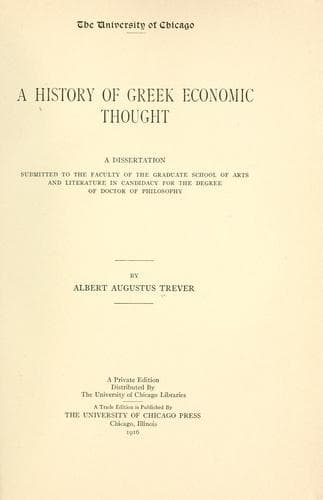
A History of Greek Economic ThoughtTrever, Albert Augustus
History
A History of Greek Economic Thought
Trever, Albert Augustus
Economics -- Greece -- History; Thesis (Ph. D.)
Footnote 126:
But cf. _Laws_ 742C (κεφάλαιον), and _infra_, under Xenophon, on the
terms for capital.
Footnote 127:
Cf. _Rep._ 552B, and p. 27. Kautz (_op. cit._, p. 119) overemphasizes
this; cf. Souchon, _op. cit._, p. 91, n. 2, who observes, however,
that Plato, by his insistence upon collectivism in landed property
implies that “la terre est toujours un capital, et que la fortune
mobilière ne l’est jamais.”
Footnote 128:
Cf. _infra_ on money.
Footnote 129:
On the general attitude toward labor in Athens, cf. p. 30, n. 4. On
Plato’s regard for the laborer, cf. _infra_, under distribution.
Footnote 130:
_Rep._ 590C, but only for him whose higher nature (τὸ τοῦ βελτίστου
εἴδος) is naturally weak, though the implication is that this is
characteristic of the artisans. Cf. Poehlmann, _op. cit._, II, 49 f.
Footnote 131:
_Laws_ 842D, 806D-E, 741E, 846D, 919D.
Footnote 132:
847A.
Footnote 133:
743D.
Footnote 134:
_Charm._ 163A-C.
Footnote 135:
_Gorg._ 517D-518E.
Footnote 136:
292E, 289E-290A.
Footnote 137:
_Ibid._ 300E.
Footnote 138:
Cf. _Rep._ 371C for a contrast in his attitude toward the two; cf.
Bonar, _op. cit._, pp. 21 f.
Footnote 139:
_Laws_ 846D, 847A. Ruskin (_Fors Clav._, Letter 82, 34 [Vol. XXIX, 253
f.]) contrasts the fevered leisure that results from extreme
money-making with the true leisure, citing _Laws_ 831.
Footnote 140:
_Laws_ 743D. The aristocratic Greek feeling of independence against
selling one’s powers to another, and the fact of the frank acceptance
of slavery, by most contemporary thinkers, as the natural order, also
exerted some unconscious influence.
Footnote 141:
Cf. _infra_ for citations from Zeller, and Poehlmann’s able, but
somewhat extreme, defense of Plato (_op. cit._, II, 36 ff.). He cites
Adam Smith, _Wealth of Nations_, V, I, Pt. 2, art. 2, in similar vein
to Plato, on the ill-effects of mechanical labor, despite his
undoubted interest in the industrial arts.
Footnote 142:
Francotte, _L’Industrie_, I, 246, in reference to the _Laws_.
Footnote 143:
_Op. cit._, p. 26, n. 2.
Footnote 144:
Eisenhart (_Geschichte der Nationalökonomie_, p. 5) also says that
Plato calls “Volkswirtschaft gerade zu den Staat der Schweine.”
Dietzel (“Beiträge zur Geschichte des Socialismus und des
Kommunismus,” _Zeitschrift für Literatur und Geschichte der
Staatswissenschaften_, p. 397, n. 1) criticizes both the foregoing.
Footnote 145:
_Sympos._ 209A; _Phileb._ 56C.
Footnote 146:
_Protag._ 321E.
Footnote 147:
_Rep._ 420E, 421C; _Laws_ 779A, 807A-E, 808C. The passages in the
_Laws_ apply particularly to the work of the soldier and the citizen.
Cf. Ruskin, _Unto This Last_, I, 22 (Vol. XVII, 40) for a similar idea
that the function of the laborer is not primarily to draw his pay, but
to do his work well.
Footnote 148:
_Rep._ 433A.
Footnote 149:
Public-domain text, read in full here on John Shaqi.
Reviews
Reviews
No reviews yet
Be the first to share your thoughts on this work.
Elsewhere in the archive
Join the Discussion
Join the discussion
Sign in to leave a comment or review.
Sign InorCreate an account