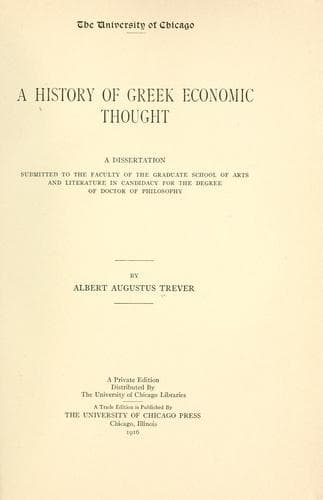
A History of Greek Economic ThoughtTrever, Albert Augustus
History
A History of Greek Economic Thought
Trever, Albert Augustus
Economics -- Greece -- History; Thesis (Ph. D.)
_Rep._ 370E-371A. In the _Laws_, he does not extend the principle to
international trade. Cf. Bonar, _op. cit._, p. 17.
Footnote 168:
Poehlmann (_op. cit._, II, 185 f.) notes a contradiction between
Plato’s insistence upon the division of labor and his desire for the
simple life. But the philosopher is aware of this, and knows that the
simpler ideal is impossible. Cf. V. Brants, _Revue de l’instr. pub. en
Belg._, XXVI (1883), 102-4, on the fact of the extensive division of
labor in Athenian industry.
Footnote 169:
δεμιουργοὺς ἐλευθερίας; _Rep._ 395C, 434A-D; cf. also 420B-421B. In
the _Laws_, the artisans and traders are non-citizens (846D, 847A,
918B-C), not because of prejudice primarily, but for the sake of
better government.
Footnote 170:
_Rep._ 374B-E.
Footnote 171:
395A-B; cf. Adam’s note to 395A, explaining _Sympos._ 223D, where
Plato asserts the opposite. He thinks Plato is speaking ideally in the
_Republic_ passage, but here of the actual fact. But cf. Shorey,
_Unity_, etc., p. 78, n. 597.
Footnote 172:
_Rep._ 433A-B, D, 434A-D, 432A, 443-444A, 396D-E; _Charm._ 161E. In
his broad application of the law, he has advanced beyond Adam Smith.
Cf. Souchon, _op. cit._, p. 81 and n. 2.
Footnote 173:
_Rep._ 397E-398A.
Footnote 174:
443C-D; cf. Nettleship _Lectures on the Republic of Plato_, p. 71.
Footnote 175:
Oncken observes (_Geschichte der Nationalökonomie_, pp. 34-36) that
while Smith drew from the law the idea of freedom of trade and
industry, Plato inferred the strictest subordination of these to the
will of the state, and that he also based the caste system on the
principle. For the alleged caste system, cf. Souchon, _op. cit._, p.
82, and infra, under distribution. Aristotle’s state implies even a
more rigid separation of the capable few. On Plato’s insight into
economic principles, cf. Robin, _op. cit._, pp. 229 ff. He criticizes
Guiraud for belittling the value of Plato’s social ideas, and urges
that he should be judged, not by the worth of his proposed remedies,
but by his scientific insight (p. 252).
Footnote 176:
_Rep._ 395A-B; 374E, 395B; εἰς σμικρότερα κατακερματίσθαι.
Footnote 177:
_Apol._ 21C-22E; cf. _Rep._ 495D-E, though it applies rather to the
evil effects of the banausic life. Cf. Bonar, _op. cit._, p. 16.
Ruskin (_Stones of Venice_, VI, 16 [Vol. X, 196]), says: It is “not
the labor that is divided but the men—divided into segments of men.”
It stunts their faculties.
Footnote 178:
_Rep._ 552A.
Footnote 179:
396C-373E; cf. Bonar, _op. cit._, p. 27.
Footnote 180:
579D.
Footnote 181:
Cf. Zimmern, _op. cit._, p. 389, note; _Laws_ 777B: δῆλον ὡς ἐπειδὴ
δύσκολόν ἐστι τὸ θρέμμα ἄνθρωπος καὶ πρὸς τὴν ἀναγκαίαν διόρισιν, τὸ
δοῦλόν τε ἔργῳ διορίζεσθαι καὶ ἐλεύθερον καὶ δεσπότην οὐδαμῶς
εὕχρηστον ἐθέλει εἶναι τε καὶ γίγνεσθαι. On his alleged caste system,
cf. above, n. 2, and _infra_.
Footnote 182:
Public-domain text, read in full here on John Shaqi.
Reviews
Reviews
No reviews yet
Be the first to share your thoughts on this work.
Elsewhere in the archive
Join the Discussion
Join the discussion
Sign in to leave a comment or review.
Sign InorCreate an account