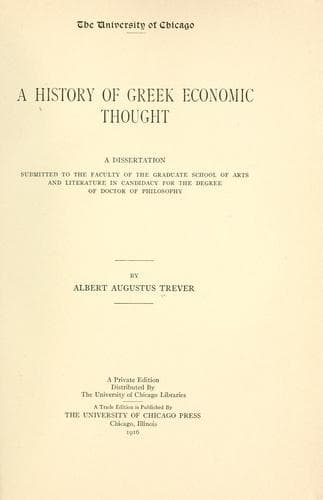
A History of Greek Economic ThoughtTrever, Albert Augustus
History
A History of Greek Economic Thought
Trever, Albert Augustus
Economics -- Greece -- History; Thesis (Ph. D.)
_Rep_. 469C; cf. _Pol._ 309A.
Footnote 183:
_Laws_ 806D. For Ruskin on slavery, cf. _infra_ on Aristotle.
Footnote 184:
_Laws_ 776D-777E. Espinas (_Revue des Etudes Grecques_, XXVII [1914],
256) observes that Plato adopts the mean between the two extremes in
his attitude to slaves.
Footnote 185:
Cf. Xen. _Ath. Pol._ i. 10-12 on the easy life of slaves in Athens,
and Zimmern, _op. cit._, pp. 382 f., who points out that this resulted
from economic necessity. Cf. 777C-D; _cf._ _Rep._ 578D-579A on the
dangers and troubles arising from extensive slave-holding.
Footnote 186:
Laws 915A ff., another striking evidence of the actual status of
freedmen and slaves in Athens.
Footnote 187:
Rep. 371B. The word is νόμισμα, something established by usage, hence
“current coin,” not necessarily suggestive of intrinsic worth, as are
χρήματα and the metals. Cf. Ar. _Clouds_ 248 for a play on the word,
θεοὶ ἡμῖν νόμισμ᾽ οὐκ ἔστι. Cf. the simile, _Frogs_ 720, and _Phaedo_
69A, for an analogy between it and wisdom.
Footnote 188:
Rep. 371B: ξύμβολον τῆς ἀλλαγῆς.
Footnote 189:
_Fors Clav._, IV, 11, note (Vol. XXVIII, 134 f.); cf. also Vol. XVII,
50, 194 f.
Footnote 190:
742A-B: νόμισμα δ᾽ ἕνεκα ἀλλαγῆς; 918B: ἐξευπορεῖν καὶ ὁμαλότητα ταῖς
οὐσίαις, referring directly to traders.
Footnote 191:
_Laws_ 918B.
Footnote 192:
_Rep._ 553E; for Aristotle, cf. _infra_.
Footnote 193:
_Laws_ 743D.
Footnote 194:
849E.
Footnote 195:
742C, 915D-E; _Rep._ 556A-B; _Laws_ 850A.
Footnote 196:
921C, an obol per month.
Footnote 197:
_Rep._ 555E.
Footnote 198:
_Fors. Clav._, notes to Letter 43, 14 (Vol. XXVIII, 121 f.), notes to
Letter 81, 16 (Vol. XXIX, 212), where he refers to Plato and
Aristotle; _Mun. Pul._, IV, 98, note (Vol. XVII, 220), where he
absolutely condemns it; On the Old Road, Vol. XXXIV, 425, on usury,
ends with a citation from the Laws 913C; ἃ μὴ κατέθου, μὴ ἀνέλη.
Footnote 199:
E.g. J. Scott Nearing’s recent book on _Income_.
Footnote 200:
_Laws_ 679B, 831C; _Rep._ 545B ff., 548B. Cf. Ruskin on the evils
arising from money, Vol. XX, 295 f.
Footnote 201:
_Laws_ 743D, 742A-B, 801B.
Footnote 202:
742A.
Footnote 203:
Ruskin, _Mun. Pul._, I, 25. He thinks it is a relic of a barbarism
that will disappear as civilization develops.
Footnote 204:
_Laws_ 742A-B.
Footnote 205:
_Sophist._ 223C-D; cf. _Pol._, 289E for the triple division of
commercials, κάπηλοι, ἔμποροι, and ἀργυραμοίβοι; cf. _Phaedo_, 69A for
a figurative use of ἀλλαγή.
Footnote 206:
_Rep._ 370A-E, home; 370E-371E, foreign; cf. Adam Smith’s idea above.
Footnote 207:
370E-371A; Cornford (_op. cit._, p. 66) wrongly asserts that Plato did
not know the law that exports must balance imports. Cf. _op. cit._, p.
37.
Footnote 208:
Public-domain text, read in full here on John Shaqi.
Reviews
Reviews
No reviews yet
Be the first to share your thoughts on this work.
Elsewhere in the archive
Join the Discussion
Join the discussion
Sign in to leave a comment or review.
Sign InorCreate an account