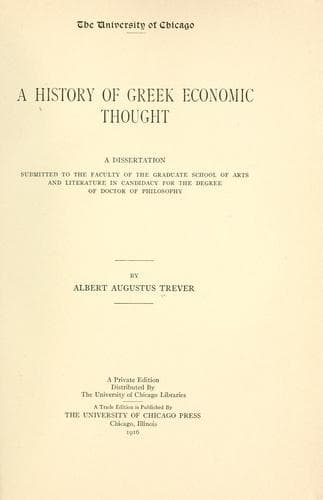
A History of Greek Economic ThoughtTrever, Albert Augustus
History
A History of Greek Economic Thought
Trever, Albert Augustus
Economics -- Greece -- History; Thesis (Ph. D.)
_Vierteljahrschrift f. Staats u. Volkswirtschaft_, I, 375 ff. Of
course Aristophanes may have caricatured Plato as he did Socrates in
the _Clouds_. However, since both were opposed to extreme
individualism, and since the comedy was written before the _Republic_,
it is improbable. But cf. Drumann, _Arbeiter u. Communisten in
Griechenland u. Rom_ (1860), pp. 133 f., who thinks the poet was
satirizing the oral discussions of Plato. Pohlenz (_op. cit._, pp.
223-28) argues for an earlier edition of the _Republic_, and states
that, though the comedy is not a direct satire on the _Republic_, yet
its numerous specific ideas and expressions that are similar to
Plato’s warrant the conclusion that the poet followed Plato. Cf. also
S. Cognetti de Martiis, (_op. cit._, pp. 541-61), on the relation of
the two.
Footnote 325:
434D-E, and the entire plan of the _Republic_. Cf. Poehlmann, (_op.
cit._, I, 527 ff.; also II, 210 f.), on Plato’s idea of a
pre-established harmony between individual and common good.
Footnote 326:
Poehlmann (_op. cit._, II, 205 ff.) suggests that this change resulted
from Plato’s experiences with Dionysius of Syracuse, but it may be
easily accounted for by the natural conservatism of age. Cf. Shorey,
_Class. Phil._, IX (1914), 353.
Footnote 327:
739D, 740A.
Footnote 328:
739C-E, 807B.
Footnote 329:
737E, 741C.
Footnote 330:
831C-D, though it refers to the love of wealth, 807B, 713E.
Footnote 331:
Cf. Guiraud (_La Prop. fonc._, pp. 582 f.); cf. _infra_ for details.
Footnote 332:
740-741A, 923A-B, a remarkable passage, which declares that they are
not full owners either of themselves or their property, but that they
belong to the whole race, past, present, and future (ξύμπαντος δέ τοῦ
γένους ὑμῶν τοῦ τε ἔμπροσθεν και τοῦ ἔπειτα ἐσομένου), and especially
to the state.
Footnote 333:
737E, 745C-E.
Footnote 334:
745C-E.
Footnote 335:
740B.
Footnote 336:
741B-C.
Footnote 337:
745A, 855A-B, 754E-755A, 744E.
Footnote 338:
740B, 923C. If the family is large, the women are to be married off,
and the men adopted by the childless (740C). Personal property may be
willed to the other children (923D); cf. also above, pp. 45 f. and
notes.
Footnote 339:
740C, 741B-D.
Footnote 340:
847E-848C.
Footnote 341:
741E.
Footnote 342:
847D, 919D.
Footnote 343:
846D, 847A, 919D.
Footnote 344:
806E.
Footnote 345:
920A; cf. above, on exchange.
Footnote 346:
849C.
Footnote 347:
Cf. p. 39 and notes.
Footnote 348:
Cf. p. 40 and notes.
Footnote 349:
742C.
Footnote 350:
Cf. p. 59 and notes.
Footnote 351:
Public-domain text, read in full here on John Shaqi.
Reviews
Reviews
No reviews yet
Be the first to share your thoughts on this work.
Elsewhere in the archive
Join the Discussion
Join the discussion
Sign in to leave a comment or review.
Sign InorCreate an account