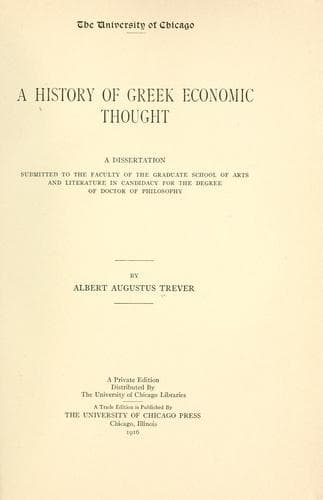
A History of Greek Economic ThoughtTrever, Albert Augustus
History
A History of Greek Economic Thought
Trever, Albert Augustus
Economics -- Greece -- History; Thesis (Ph. D.)
744E. The entire wealth will thus vary from the bare lot to five times
its value. Cf. Jowett, _Dialogs of Plato_, 3d ed., V, 127, though the
division into four classes might mean that the highest was only four
times the lot value. Espinas (_Revue des Etudes Grecques_, XXVII
[1914], 237) accepts the former interpretation.
Footnote 352:
54D-E. The value of the lot was thus only a mina.
Footnote 353:
744E, 745A.
Footnote 354:
745A, 754D-E (which requires it only for the excess), 755A. Espinas
(_op. cit._, pp. 118 ff.) emphasizes the ascetic tendency of his
regulations.
Footnote 355:
729A ff., 919B, 936B-C, against beggars.
Footnote 356:
744B-E, and above notes.
Footnote 357:
Book VII.
Footnote 358:
780B; women and children separate, 806E; on its Cretan origin, 625E
ff.
Footnote 359:
846D, 847A, D, 919D, 806E.
Footnote 360:
744B; cf. pp. 55 f. on equality; cf. 757B-D, contrasting the mere
arithmetical equality (τὴν ἀριθμῷ ἴσην), which is easily realized, and
the true equality, which is very difficult. This latter apportions to
each in accord with his nature (πρὸς τὴν φύσιν αὐτῶν). The two are
almost opposites (ἐναντιαῖν). Espinas (_op. cit._, p. 236) thinks that
the division into property classes in the _Laws_ is an attempt to
realize this principle.
Footnote 361:
744B.
Footnote 362:
736C-D, 704.
Footnote 363:
_Op. cit._, p. 143; cf. also pp. 163-65, where he compares it to
modern collectivism; cf. p. 162; also Poehlmann, _op. cit._, II, 295.
Footnote 364:
923A; cf. 877D, and much of the legislation on property, above.
Footnote 365:
Cf. pp. 59 f. and notes. The modern analogy is not close, yet in each
case the aim is to prevent undue gains whereby the public is
oppressed.
Footnote 366:
Cf. p. 30, n. 3.
Footnote 367:
Cf. p. 59 and notes. The socialistic tendency to overemphasize the
power of law is also strong here as in the _Republic_. But cf. p. 36,
n. 4, and _Laws_ 807B, 746A-B, 747B.
Footnote 368:
_Time and Tide_, IX, 5-9. Modern Painters, V, Pt. 8, chap. i, 6 (Vol.
VII, 207). Espinas (_Revue des Etudes Grecques_, XXVII [1914], 246)
calls this Platonic denial of “conflict of interest” in trade “le
thème éternel de la chimère socialiste.”
Footnote 369:
Laws 626E: τὸ πολεμίους εἶναι πάντας πᾶσιν; cited by Poehlmann, _op.
cit._, I, 557; but he exaggerates the analogy.
Footnote 370:
Cf. 742D-E, 743D-E, 729A, and the remarks on retail trade, 918B-919E,
870B; cf. also, above, on wealth.
Footnote 371:
As seen above, they are all slaves or strangers. A direct comparison
is hardly possible, since in the _Republic_, the masses are the
majority of the citizens, while in the _Laws_, there are none.
Footnote 372:
Public-domain text, read in full here on John Shaqi.
Reviews
Reviews
No reviews yet
Be the first to share your thoughts on this work.
Elsewhere in the archive
Join the Discussion
Join the discussion
Sign in to leave a comment or review.
Sign InorCreate an account