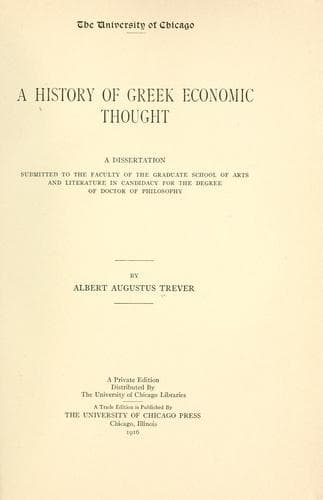
A History of Greek Economic ThoughtTrever, Albert Augustus
History
A History of Greek Economic Thought
Trever, Albert Augustus
Economics -- Greece -- History; Thesis (Ph. D.)
744D; cf. Shorey, _Class. Phil._, IX (1914), 363: “Plato’s object,
however, is not socialistic equalization of the ‘good things’ of life,
but the enforced disinterestedness of the rulers, and the complete
self-realization of every type of man, in limitation to his own proper
sphere and task.”
Footnote 373:
Cf. pp. 55 and 60, on equality; also note 4, above.
Footnote 374:
Francotte (_L’Industrie_, II, 250) suggests that _l’étatisme_,
“nationalism,” would be a more applicable term for the _Laws_. He
distinguishes this from socialism, as being not so thoroughgoing a
limitation of the individual as is the “socialism” of the _Republic_.
Cf. Shorey, _Class. Phil._, IX (1914), 358, on the famous
“communistic” passage in _Laws_ 739C: ὄντως ἐστὶ κοινὰ τὰ φίλων, etc.
He calls it a “rhetorical exaltation of that ideal unity of civic
feeling, which Demosthenes upbraids Aeschines for not sharing.” For
further communistic ideas of Plato, cf. his incomplete romantic story
of Atlantis in the _Critias_. The ideal is similar to that of the
larger works. Cf. Poehlmann, _op. cit._, II, 348 ff.
CHAPTER IV
XENOPHON
Xenophon was a man of affairs, whose interests touched the practical
life of the world on many sides, as is evidenced by the broad scope of
his extant works. He was also, however, a pupil of Socrates. In his
economic thought, therefore, he vacillates between the positive interest
of the practical economist and the negative criticism of the
Socratics.[375] On the whole, his practical bent dominates, and is
especially exhibited in his essay on the _Revenues of Athens_,[376] as
also in the fact that he was the first writer to produce a work devoted
entirely to economics.[377] The spirit of the moral philosopher, on the
other hand, is prominent wherever the influence of Socrates is felt, as
in the first chapters of the _Economicus_ and in the _Memorabilia_. When
the Socratic ideal dominates, he, in common with other Greek thinkers,
confuses economics with ethics, and private with public economy.[378] He
makes the science of economy deal with the management of private
estates,[379] and believes with Plato and Ruskin that the same qualities
are necessary for the successful handling of the affairs of either house
or state.[380]
VALUE
Public-domain text, read in full here on John Shaqi.
Reviews
Reviews
No reviews yet
Be the first to share your thoughts on this work.
Elsewhere in the archive
Join the Discussion
Join the discussion
Sign in to leave a comment or review.
Sign InorCreate an account