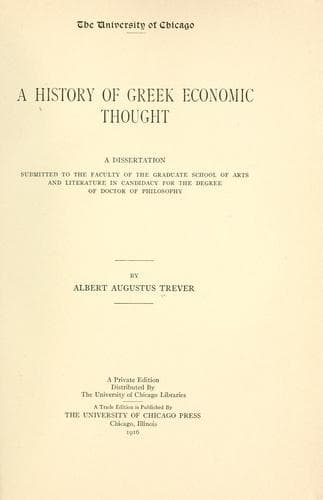
A History of Greek Economic ThoughtTrever, Albert Augustus
History
A History of Greek Economic Thought
Trever, Albert Augustus
Economics -- Greece -- History; Thesis (Ph. D.)
Xenophon insists strongly on utility or serviceableness as a necessary
quality of property (χρήματα, κτήματα). By this, however, he means
primarily, not potential utility in the object, but ability of the owner
to use rightly.[381] Even exchangeability does not insure value in
anything, unless the seller can use to advantage that which he receives
in return.[382] This idea of value is true enough from the ethical
standpoint, and should not be left out of account, as is being
recognized by modern economists. But to attempt to build a theory of
economic value on such a basis, as Ruskin does,[383] would result in
hopeless confusion. Value is not merely an individual and moral, but
also a social and economic, fact.
A hint of exchange value is given in the implied classification of goods
as usable or salable.[384] But there is no discrimination between useful
things in the economic and uneconomic sense. In the _Revenues_, on the
other hand, when free from Socratic influence, Xenophon makes a positive
contribution to the theory of value. He observes that the exchange value
of goods varies with supply and demand, and that this law is, in a
sense, self-regulative by the fact that workmen tend to enter other
fields of activity whenever any industry becomes unprofitable through an
oversupply of its products.[385]
WEALTH
The double standpoint of Xenophon is well illustrated in his doctrine of
wealth. On the one hand, he values it highly, and tries to deduce
practical rules for its increase and enjoyment.[386] On the other hand,
like Socrates and Plato, he makes derogatory comparisons between
economic and spiritual wealth.[387] As in the case of value, he offers
no clear definition of economic wealth (κτῆσις). It is defined
indiscriminately as “whatever is useful to life,” and “useful” is
“everything that anyone knows how to use.”[388] But, as seen above, this
is a purely subjective notion, and is only one element in economic
wealth.[389] He also defines it (χρήματα) as “the excess of goods over
needs,” making it a merely relative term:[390] but here again the
thought is ethical rather than economic, an attempt to teach the
somewhat ascetic principle that a man’s riches are measured by the
paucity of his wants.[391] The hostile or indifferent attitude to wealth
is also assumed in the comparison of it with so-called mental wealth and
wisdom[392] and in the implication that it involves many cares.[393] The
idea so prominent in Plato, however, that the acquisition or expenditure
of great wealth is not consistent with justice, is not emphasized by
Xenophon. He calls that man happiest who has best succeeded in just
acquisition, and who uses his wealth in the best manner.[394]
PRODUCTION
Public-domain text, read in full here on John Shaqi.
Reviews
Reviews
No reviews yet
Be the first to share your thoughts on this work.
Elsewhere in the archive
Join the Discussion
Join the discussion
Sign in to leave a comment or review.
Sign InorCreate an account