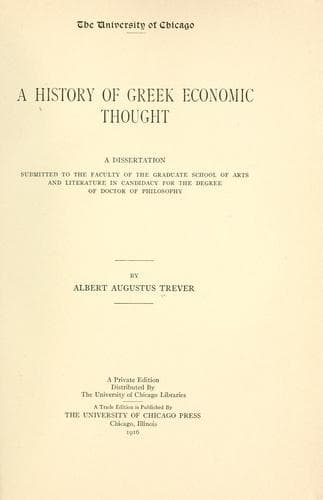
A History of Greek Economic ThoughtTrever, Albert Augustus
History
A History of Greek Economic Thought
Trever, Albert Augustus
Economics -- Greece -- History; Thesis (Ph. D.)
DISTRIBUTION
In the _Ethics_ passage discussed above,[775] Aristotle approaches a
scientific theory of distribution. He observes that just distribution
will be a mean between two extremes of unfairness.[776] Unlike some
moderns, however, he realizes that this will not mean equal shares for
all. There must be the same ratio between the persons, or services, and
the things.[777] In the “mutual exchange of services,” the law must be
proportional requital.[778] In other words, each should receive an
equivalent to what he contributes.[779] Distribution must thus proceed
according to a certain standard of worth or desert (κατ᾽ ἀξίαν
τινά).[780] If the individuals are unequal, their shares cannot be
equal, and it is a prolific source of dispute, whenever equals receive
unequal shares, or unequals receive equal.[781] On the other hand,
Aristotle recognizes that it is a difficult matter to determine this
standard, by which just distribution is to proceed.[782] At this point,
again, he shows clearly that his paramount interest in the problem is
not economic. He names four possible standards—freedom, wealth, noble
birth, and general excellence—all of which are distinctly political in
their reference.[783]
Though he insists on a fair distribution of wealth to the citizens, he
can hardly be said to exhibit as much interest in the welfare of the
common people as does Plato. He had not a very ideal conception of human
nature in general. He would have thought it not only impracticable, but
undesirable to give his doctrine of leisure any extensive application.
As seen above, he includes all hired labor under false finance, and
relegates all industry, including agriculture, to the slaves and
strangers. The life of mechanic and commercial alike is to him
ignoble.[784] He advises that measures be taken to hold the workers in
submission and obedience.[785] His unfair criticism of Plato’s
_Republic_, however, on the ground that it fails to emphasize
sufficiently the welfare of the parts of the state, and that it does not
distinguish clearly enough the status of the commons, reveals a spirit
that does not entirely disregard the masses.[786] His demand that no
citizen shall lack subsistence,[787] his provision of the _sussitia_ for
all,[788] his insistence that, in the market, mere economic
self-interest shall not rule,[789] and his emphasis on the importance of
a strong middle class in the state,[790] all show that, in the interest
of the perpetuity of the state at least, he had some regard for the
economic well-being of all classes. It would be wrong to infer from his
suggestions for the aid of the masses in a democracy, that he would
offer similar advice for the ideal state. Moreover, his chief emphasis
in the passage is upon the idea of Mill, that mere hand-to-mouth help of
the poor is wasteful, and that what is needed is to aid them to become
economically independent.[791] Nevertheless his suggestion does show
Public-domain text, read in full here on John Shaqi.
Reviews
Reviews
No reviews yet
Be the first to share your thoughts on this work.
Elsewhere in the archive
Join the Discussion
Join the discussion
Sign in to leave a comment or review.
Sign InorCreate an account