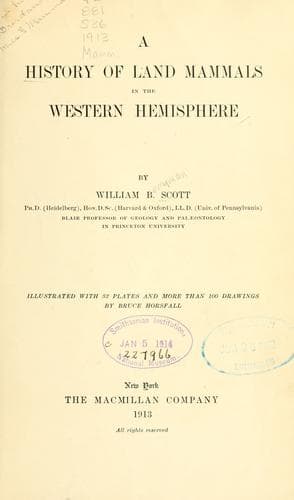
A history of land mammals in the western hemisphereScott, William Berryman
History
A history of land mammals in the western hemisphere
Scott, William Berryman
Mammals; Mammals, Fossil
{ Permian period
{ Carboniferous period
Palæozoic era { Devonian period
{ Silurian period
{ Ordovician period
{ Cambrian period
Pre-Cambrian eras { Algonkian period
{ Archæan period
It must not be supposed that all the divisions of similar rank, such as
the eras, for example, were of equal length, as measured by the thickness
of the rocks assigned to those divisions. On the contrary, they must
have been of very unequal length and are of very different divisibility.
The Pre-Cambrian eras, with only two periods, were probably far longer
than all subsequent time, and all that the major divisions imply is that
they represent changes in the system of life of approximately equivalent
importance. It is impossible to give any trustworthy estimate of the
actual lengths of these divisions in years, though many attempts to do so
have been made. All that can be confidently affirmed is that geological
time, like astronomical distances, is of inconceivable vastness and its
years can be counted only in hundreds of millions.
To discuss in any intelligible manner the history of mammals, it will be
necessary to go much farther than the above table in the subdivision of
that part of geological time in which mammalian evolution ran its course.
As mammals represent the highest stage of development yet attained in the
animal world, it is only the latter part of the earth’s history which
is concerned with them; the earlier and incomparably longer portion of
that history may be passed over. Mammals are first recorded in the later
Triassic, the first of the three periods which make up the Mesozoic era.
They have also been found, though very scantily, in the other Mesozoic
periods, the Jurassic and Cretaceous, but it was the Cenozoic era that
witnessed most of the amazing course of mammalian development and
diversification, and hence the relatively minute subdivisions necessary
for the understanding of this history deal only with the Cenozoic, the
latest of the great eras.
In the subjoined table the periods and epochs are those which are in
general use throughout the world, the ages and stages are those which
apply to the western interior of North America, each region, even of the
same continent, requiring a different classification. The South American
formations are given in a separate table, as it is desirable to avoid the
appearance of an exactitude in correlation which cannot yet be attained.
CENOZOIC ERA
Quaternary period { Recent epoch
{ Pleistocene epoch = Glacial and Interglacial stages.
{ Pliocene epoch
{ Miocene epoch
Tertiary period { Oligocene epoch
{ Eocene epoch
{ Paleocene epoch
Continuing the subdivision of the Tertiary period still farther, we have
the following arrangement:
Public-domain text, read in full here on John Shaqi.
Reviews
Reviews
No reviews yet
Be the first to share your thoughts on this work.
Join the Discussion
Join the discussion
Sign in to leave a comment or review.
Sign InorCreate an account