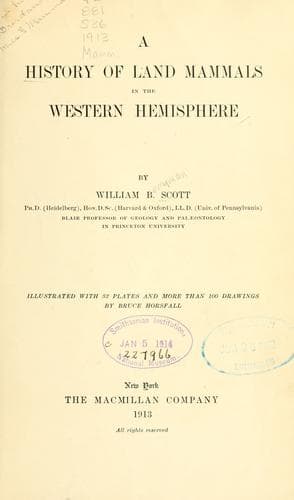
A history of land mammals in the western hemisphereScott, William Berryman
History
A history of land mammals in the western hemisphere
Scott, William Berryman
Mammals; Mammals, Fossil
TERTIARY PERIOD (North America)
{ Upper Wanting
{ Middle Blanco age
_Pliocene_ { { Thousand Creek age
{ Lower { Snake Creek age
{ { Republican River age
{ Upper Loup Fork age
_Miocene_ { Middle Deep River age
{ Lower Arikaree age
_Oligocene_ { Upper John Day age
{ Lower White River age
{ Upper Uinta age
_Eocene_ { Middle Bridger age
{ Lower { Wind River age
{ Wasatch age
_Paleocene_ { Upper Torrejon age } Fort Union
{ Lower Puerco age }
This is a representative series of the widespread and manifold non-marine
Tertiary deposits of the Great Plains, but a much more extensive and
subdivided scheme would be needed to show with any degree of fullness
the wonderfully complete record of that portion of the continent during
the Tertiary period. A much more elaborate table will be found in
Professor Osborn’s “Age of Mammals,” p. 41. There are some differences
of practice among geologists as to this scheme of classification, though
the differences are not those of principle. No question arises concerning
the reality of the divisions, or their order of succession in time, but
merely as to the rank or relative importance which should be attributed
to some of them, and that is a very minor consideration.
Much greater difficulty and, consequently, much more radical differences
of interpretation arise when the attempt is made to correlate or
synchronize the smaller subdivisions, as found in the various continents,
with one another, because of the geographical differences in contemporary
life. Between Europe and North America there has always been a certain
proportion of mammalian forms in common, a proportion that was at
one time greater, at another less, and this community renders the
correlation of the larger divisions of the Tertiary in the two continents
comparatively easy, and even in the minor subdivisions very satisfactory
progress has been made, so that it is possible to trace in some detail
the migrations of mammals from the eastern to the western hemisphere and
_vice versa_. Such intermigrations were made possible by the land-bridges
connecting America with Europe across the Atlantic, perhaps on the line
of Greenland and Iceland, and with Asia where now is Bering Strait.
These connections were repeatedly made and repeatedly broken during the
Mesozoic and Cenozoic eras down to the latest epoch, the Pleistocene.
By comparing the fossil mammals of Europe with those of North America
for any particular division of geological time, it is practicable to
determine whether the way of intermigration was open or closed, because
separation always led to greater differences between the faunas of the
two continents through divergent evolution.
Public-domain text, read in full here on John Shaqi.
Reviews
Reviews
No reviews yet
Be the first to share your thoughts on this work.
Join the Discussion
Join the discussion
Sign in to leave a comment or review.
Sign InorCreate an account