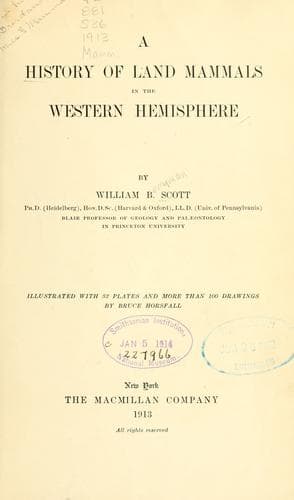
A history of land mammals in the western hemisphere — John Shaqi
A history of land mammals in the western hemisphereScott, William Berryman
History
A history of land mammals in the western hemisphere
Scott, William Berryman
Mammals; Mammals, Fossil
It is of particular interest to inquire how far the fossils of Glacial
times confirm the inferences as to a great climatic change which are
derived from a study of the rocks, for this may be taken as a test-case.
Any marked discrepancy between the two would necessarily cast grave doubt
upon the value of the testimony of fossils as to climatic conditions.
The problem is one of great complexity, for the Pleistocene was not one
long epoch of unbroken cold, but was made up of Glacial and Interglacial
ages, alternations of colder and milder conditions, and some, at least,
of the Interglacial ages had a climate warmer than that of modern times.
Such great changes of temperature led to repeated migrations of the
mammals, which were driven southward before the advancing ice-sheets
and returned again when the glaciers withdrew under the influence
of ameliorating climates. Any adequate discussion of these complex
conditions is quite out of the question in this place and the facts must
be stated in simplified form, as dealing only with the times of lowered
temperature and encroaching glaciers.
The plants largely fail us here, for little is known of Glacial
vegetation, but, on the other hand, a great abundance of the fossil
remains of animal life of that date has been collected, and its testimony
is quite in harmony with that afforded by the ice-markings and the
ice-made deposits. Arctic shells in the marine deposits of England, the
valley of the Ottawa River and of Lake Champlain, Walruses on the coast
of New Jersey, Reindeer in the south of France, and Caribou in southern
New England, Musk-oxen in Kentucky and Arkansas, are only a few examples
of the copious evidence that the climate of the regions named in Glacial
times was far colder than it is to-day.
I have thus endeavored to sketch, necessarily in very meagre outlines,
the nature of the methods employed to reconstruct the past history of
the various continents and the character of the evidence upon which we
must depend. Should the reader be unconvinced and remain sceptical as to
the possibility of any such reconstruction, he must be referred to the
numerous manuals of Geology, in which these methods are set forth with a
fulness which cannot be imitated within the limits of a single chapter.
The methods are sound, consisting as they do merely in the application of
“systematized common sense” (in Huxley’s phrase) to observed facts, but
by no means all applications of them are to be trusted. Not to mention
ill-considered and uncritical work, or inverted pyramids of hypothesis
balanced upon a tiny point of fact, it should be borne in mind that
such a complicated and difficult problem as the reconstruction of past
conditions can be solved only by successive approximations to the truth,
each one partial and incomplete, but less so than the one which preceded
it.
CHAPTER II
METHODS OF INVESTIGATION—PALÆONTOLOGICAL
Public-domain text, read in full here on John Shaqi.
Reviews
Reviews
No reviews yet
Be the first to share your thoughts on this work.
Join the Discussion
Join the discussion
Sign in to leave a comment or review.
Sign InorCreate an account