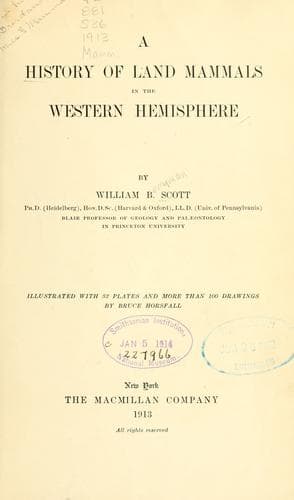
A history of land mammals in the western hemisphereScott, William Berryman
History
A history of land mammals in the western hemisphere
Scott, William Berryman
Mammals; Mammals, Fossil
Palæontology is the science of ancient life, animal and vegetable, the
Zoölogy and Botany of the past, and deals with fossils. Fossils are the
recognizable remains or traces of animals or plants, which were buried in
the rocks at the time of the formation of those rocks. In a geological
sense, the term _rock_ includes loose and uncompacted materials, such as
sand and gravel, as well as solid stone. Granting the possibility of so
determining the relative dates of formation of the rocks, that the order
of succession of the fossils in time may be ascertained in general terms,
the question remains: What use, other than geological, can be made of the
fossils? In dealing with this question, attention will be directed almost
exclusively to the mammals, the group with which this book is concerned.
As a preliminary to the discussion, something should be said of the
ways in which mammals became entombed in the rocks in which we find
them. In this connection it should be remembered that, however firm and
solid those rocks may be now, they were originally layers of loose and
uncompacted material, deposited by wind or water, and that each layer
_formed in its turn the surface of the earth, until buried by fresh
accumulations upon it_, it may be to enormous depths.
One method of the entombing of land-mammals, which has frequently been
of great importance, is burial in volcanic dust and so-called ash, which
has been compacted into firm rock. During a great volcanic eruption
enormous quantities of such finely divided material are ejected from the
crater and are spread out over the surrounding country, it may be for
distances of hundreds of miles. Thus will be buried the scattered bones,
skeletons, carcasses, that happen to be lying on the surface; and if the
fine fragments are falling rapidly, many animals will be buried alive and
their skeletons preserved intact. A modern instance of this is given by
the numerous skeletons of men and domestic animals buried in the volcanic
ash which overwhelmed Pompeii in 79 A.D. Pliny the Younger, who witnessed
that first recorded eruption of Vesuvius, tells us in a letter written to
Tacitus, that far away at Misenum, west of Naples, it was often necessary
to rise and shake off the falling ashes, for fear of being buried in
them. In the Santa Cruz formation of Patagonia (see p. 124), which has
yielded such a wonderful number and variety of well-preserved fossils,
the bones are all found in volcanic dust and ash compacted into a rock,
which is usually quite soft, but may become locally very hard. The
Bridger formation of Wyoming (p. 110) and the John Day of eastern Oregon
(p. 116) are principally made up of volcanic deposits; and no doubt there
are several others among the Tertiary stages which were formed in the
same way, but have not yet received the microscopic study necessary to
determine this.
Public-domain text, read in full here on John Shaqi.
Reviews
Reviews
No reviews yet
Be the first to share your thoughts on this work.
Join the Discussion
Join the discussion
Sign in to leave a comment or review.
Sign InorCreate an account