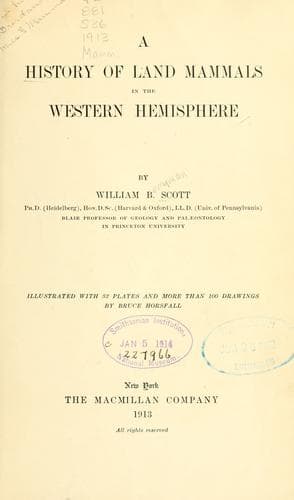
A history of land mammals in the western hemisphere — John Shaqi
A history of land mammals in the western hemisphereScott, William Berryman
History
A history of land mammals in the western hemisphere
Scott, William Berryman
Mammals; Mammals, Fossil
While the foregoing account by no means exhausts the various methods
of accumulation and burial of the skeletons and scattered bones of
mammals, it covers the more important of these methods sufficiently for
a general understanding of the different processes. In whatever manner
the preservation may have been effected, there is great difference in
the relative abundance and completeness among the fossils of the various
kinds of mammals which were living at the same time and in the same
area. It need hardly be said, that the more abundant any species was,
the better was the chance of its being represented among the fossils;
hence, gregarious species, living in large herds, were more likely to be
preserved than those which led a solitary existence, or were individually
rare. Most of the hoofed mammals are and apparently always have been
gregarious, and are therefore much better represented among the fossils,
and are, in consequence, better known than the beasts of prey, which,
of necessity, were individually less numerous and generally solitary
in habits. Not only this, but large and medium-sized mammals, with
strong and heavy bones, were better fitted to withstand the accidents of
entombment and subsequent preservation than small creatures with delicate
and fragile skeletons. The mere dead weight of over-lying sediments often
crushes and distorts the bones, and the movements of uplift, compression,
folding and fracture, to which so many strata have been subjected, did
still further damage to the fossils. The percolating waters, which for
ages have traversed the porous rocks, often attack and dissolve the
bones, completely destroying the minute ones and greatly injuring those
which are massive and strong. In consequence of all those accidents it
frequently happens that only the teeth, the hardest and most resistant
of animal structures, and it may be the dense and solid jaw-bones, are
all that remain to testify of the former existence of some creature that
long ago vanished from the earth. Very many fossil mammals are known
exclusively from the teeth, and it is this fact which makes the exact
study of teeth so peculiarly important to the palæontologist.
Public-domain text, read in full here on John Shaqi.
Reviews
Reviews
No reviews yet
Be the first to share your thoughts on this work.
Join the Discussion
Join the discussion
Sign in to leave a comment or review.
Sign InorCreate an account